Is There A High-Speed Train From Athens To Thessaloniki?
Hellenic Train runs the Athens to Thessaloniki route, but is it a high-speed train? What the operator publishes, what to confirm before booking, and what to do once you arrive in Thessaloniki.
Thessaloniki, the second city of Greece, sits in Central Macedonia on the Thermaic Gulf, north of the Greek capital, and the train between the two cities is a question travellers ask constantly, usually with the words "high-speed" attached. The honest answer is narrower than the question suggests. Hellenic Train, the national operator, runs the Athens to Thessaloniki route and also serves northern Greece destinations such as Larissa, Litochoro, Katerini, Veria, Edessa and Florina from the same city-centre station. That is not a complaint about the railway. It is a reminder that the words matter: buying a ticket is easy once you know what the timetable actually says, and the timetable lives on the operator's site, not in a search result.
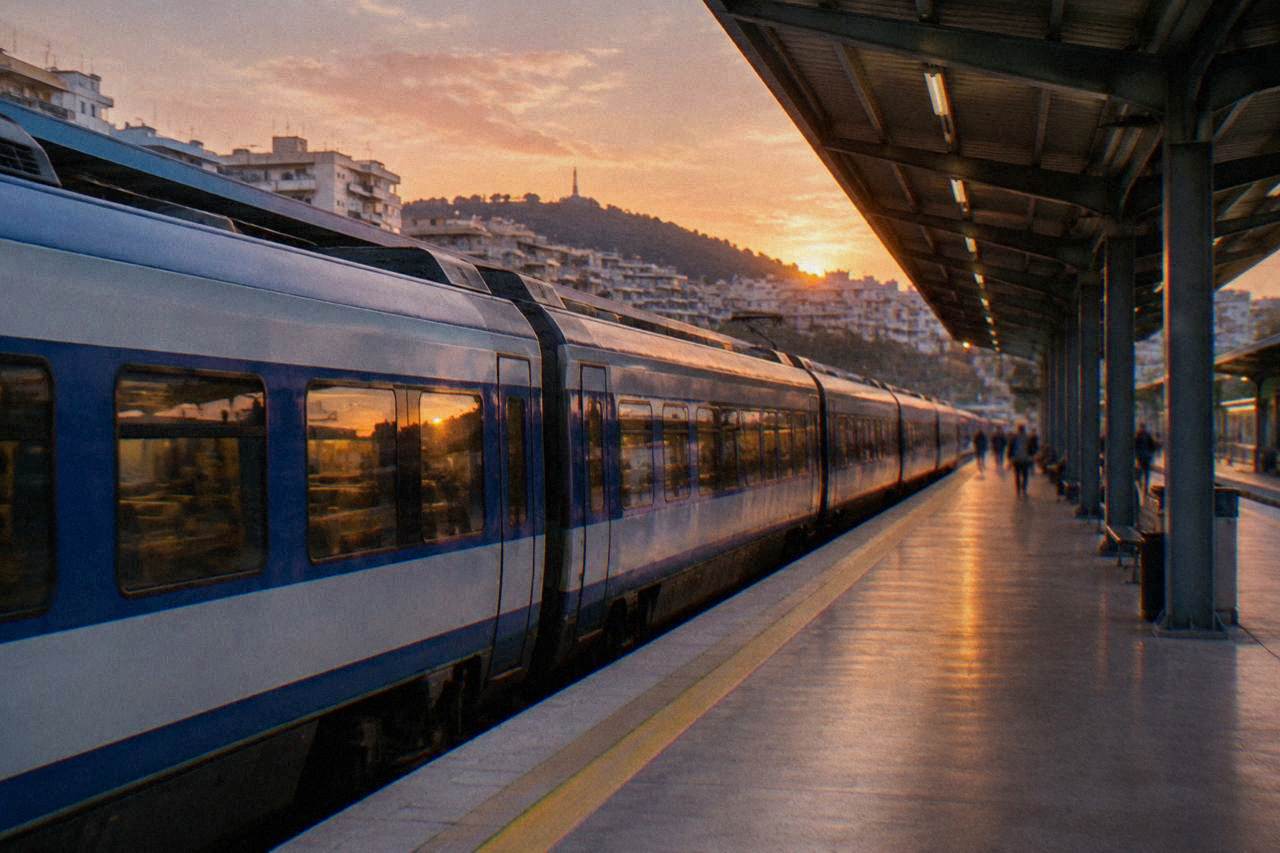
Is There A High-Speed Train From Athens To Thessaloniki?
Hellenic Train operates the Athens to Thessaloniki route as its main intercity line, but the operator does not market it on its own site as a "high-speed" service, and no journey time, fare or frequency for the run can be stated here. Travellers should read the current timetable and prices on the Hellenic Train site before booking, and treat the high-speed label as a marketing word rather than a guarantee.
The distinction is worth a paragraph on its own. In much of Europe "high-speed" names a specific category: trains on dedicated lines running at very high cruise speeds, such as the premier services of France or Spain. Greece's mainline railway north from Athens passes through Larissa and Katerini on a conventional corridor, and whatever the top speed of an individual train, nothing in the operator's published material seen for this page makes a high-speed claim. Some resellers and older articles do. Treat those descriptions loosely, and check the Athens to Thessaloniki timetable PDF on the operator's own site, which lists actual departures and arrivals, before you plan a connection.
What is confirmed is simpler and more useful. The route exists, it is the spine of the Greek rail network, and it lands you at the New Railway Station in Thessaloniki, a short hop from the centre of a walkable city where the metro now runs as well. For the wider picture of the two cities compared, see the Athens to Thessaloniki route guide, and for the question of which city suits you better, the comparison in which is nicer, Athens or Thessaloniki covers it honestly.
What Does Hellenic Train Actually Publish About The Route?
Anything numerical about the run should therefore be read off the operator's current timetable before booking.
The operator publishes its timetables per corridor, so the Athens to Thessaloniki services appear inside the Larissa corridor document, with intermediate stations listed stop by stop. That is the practical tool: open the PDF, find the departure window that suits your flight or ferry into Athens, and read the arrival time into Thessaloniki directly rather than trusting a summary written anywhere else, including here.
Two practical notes about the arrival end. First, Thessaloniki's New Railway Station is the northern terminus and also the western terminus of the city's metro: Line 1 has run from the New Railway Station to Nea Elvetia since November 2024, and the Kalamaria extension, inaugurated 27 August 2026, added five more stations out to Mikra. Second, the metro's own ticket page states a basic single ticket of 0.60 euro and a 24-hour ticket of 2.50 euro, with service from 05:15 to 00:30 Sunday to Thursday and to 02:00 on Friday and Saturday nights. The Thessaloniki train station guide covers the arrival practicalities in detail.
Once you are off the train, the city starts immediately. A rail arrival into Thessaloniki puts you within a short metro ride of Aristotelous Square, the White Tower on the seafront promenade, and the Ladadika district, and the city rewards travellers who arrive by train by being compact enough to explore on foot the same afternoon. The walking tour with city highlights is one way to compress that first orientation into a single outing.
How Does The Train Compare With Flying And Driving?
The sources for this page do not give an Athens to Thessaloniki train time, air journey time or road time, so no side-by-side minute count can be offered. What the sources do give is the rail network's reach north from Thessaloniki, free-flow road times to the northern destinations, and the fact that the city's airport is 16.4 km and about 20 minutes by road from Aristotelous Square.
The choice between train and plane therefore comes down to the timetable and the fare you see on the day. What can be reported plainly is the geography of the arrival. Thessaloniki Airport "Makedonia", IATA code SKG, is operated by Fraport Greece and sits about 16.4 km from Aristotelous Square, roughly 20 minutes by road, with airport bus lines and taxis listed on the airport's own information page. The train, by contrast, delivers you inside the city at the New Railway Station, already on the metro line. For a traveller whose final destination is central Thessaloniki, that last-kilometre arithmetic matters more than the headline speed of the vehicle.
For anyone weighing the train against the road north of Thessaloniki rather than south of it, the computed free-flow road times below give the honest scale of northern Greece from the city centre. These are routing figures without traffic, parking or stops, so treat each as "about".
| Destination from Thessaloniki centre | Road distance | Free-flow time |
|---|---|---|
| Amphipolis | 100 km | 78 min |
| Kavala | 155 km | 118 min |
| Philippi | 156 km | 127 min |
| Kastoria | 193 km | 130 min |
| Meteora (Kalambaka) | 228 km | 154 min |
| Skopje | 228 km | 173 min |
| Sofia | 294 km | 221 min |
The Meteora row deserves its own caution, because it is where train fantasies and road reality diverge most. Kalambaka is about 228 km away by road, roughly two and a half hours of driving in free-flow conditions, which makes it a full-day trip from Thessaloniki however you travel. The question of is Meteora closer to Athens or Thessaloniki comes up often on exactly this route, and the answer shapes whether the monasteries belong at the Athens end or the Thessaloniki end of a Greek itinerary.
What Should You Confirm Before Booking The Athens Train?
Confirm three things on the Hellenic Train site before you commit: the current departure and arrival times in the corridor timetable PDF, the fare for the class and date you want, and the seat-reservation rules for your ticket type, because none of those figures is carried on this page. Also confirm any onward connection in Thessaloniki, since a late arrival changes what is realistic on the same evening.
The booking-first checklist is short. Read the timetable PDF, not a summary of it. Check whether your ticket requires a seat reservation or allows any train. And if your train gets in late, the metro runs until 00:30 Sunday to Thursday and 02:00 on Friday and Saturday nights, after which a taxi is the fallback. Other pages covering the same trip are gathered on Thessaloniki Travel Guide.
Two common misconceptions are worth correcting once. Older guides still describe Thessaloniki as a city with no metro or a metro under construction, which is out of date: Line 1 opened in November 2024 and the Kalamaria extension in August 2026. And the metro ticket page does not state that the 0.60 euro ticket is valid on city buses, so buy separately for bus legs rather than assuming integration.

What Can You Do On Arrival Day In Thessaloniki?
A train arrival into Thessaloniki lands you at the New Railway Station, on the metro line, a short ride from a city centre that holds the White Tower, Aristotelous Square, fifteen UNESCO-listed Paleochristian and Byzantine monuments inscribed in 1988, and the Roman Galerian complex, so a first afternoon can be genuinely full even with check-in pending.
The shape of a first half-day writes itself. Ride the metro or walk to the centre, put the White Tower on the seafront promenade first, then follow the waterfront to Aristotelous Square and cut inland to the Arch of Galerius and the Rotunda, the Roman monuments that anchor the eastern half of the centre. Entry to the White Tower is 8 euro full and 4 euro reduced, per the Museum of Byzantine Culture's visiting page, in force from 1 April 2026, with summer opening to 21:00 and winter opening to 15:30, so late rail arrivals can still climb it in the lighter months. Working churches such as the Church of Saint Demetrius and Hagia Sophia are free to enter outside services.
For an indoor first stop, especially with children or with weather to dodge, the Museum of Illusions sits in the centre as a compact, pre-bookable option: Check availability. It pairs naturally with the Museum of Illusions admission ticket page on this site.
Food is the other arrival-day anchor. Thessaloniki's markets, Modiano Market and Kapani Market among them, sit within walking distance of the square, and a market walk is the fastest way into the city's food culture after a long sit on a train. A guided tasting gives the same streets a structure, and the open market food tour with tasting is built exactly around that idea.
Is The Train The Right Way To Reach Thessaloniki At All?
The train is a real, operating option on the country's main intercity corridor, and it delivers you into the centre of a walkable, coastal, second city of Greece, but whether it beats a flight depends entirely on the timetable, the fare and your tolerance for a long sit. Confirm the current times on the Hellenic Train site, then decide.
The city holds fifteen UNESCO-inscribed Paleochristian and Byzantine monuments, a Roman imperial complex, an upper old town inside the Byzantine walls, and a seafront promenade that runs along the Thermaic Gulf, with Halkidiki, Pella, Vergina, Dion, Mount Olympus, Edessa and Meteora as day trips beyond it. If the question behind your train search is really "is it worth it", the answer in is Thessaloniki worth visiting and in how many days is enough for Thessaloniki is a considered yes, with the length of stay doing more for the trip than the speed of the train.
Common Questions About The Athens To Thessaloniki Train
Is there a high-speed train from Athens to Thessaloniki?
Read the current corridor timetable PDF on the Hellenic Train site before booking.
How long does the train from Athens to Thessaloniki take?
The operator publishes the corridor timetable as a downloadable PDF with every departure and arrival listed; read your specific service's times there before planning connections.
How much is a train ticket from Athens to Thessaloniki?
Fares are sold through the operator's own channels, so check the price for your date and class on the Hellenic Train site at booking time.
Where does the train arrive in Thessaloniki?
Trains from Athens arrive at Thessaloniki's New Railway Station, which is also the western terminus of the metro. Line 1 has run from the New Railway Station to Nea Elvetia since November 2024, and the Kalamaria extension to Mikra was inaugurated on 27 August 2026.
Is Thessaloniki Airport an alternative to the train?
Yes. Thessaloniki Airport "Makedonia" (SKG) is about 16.4 km and 20 minutes by road from Aristotelous Square, and the airport's own information page lists the public bus and taxi connections. Whether flying beats the train depends on the fares and times you find on the day.
Can you continue by train from Thessaloniki to other parts of northern Greece?
Yes. Hellenic Train serves Larissa, Litochoro, Katerini, Veria, Edessa and Florina from Thessaloniki, and the KTEL network covers the destinations the rail lines miss, including the Halkidiki coaches run by KTEL Chalkidikis. Confirm times and fares with each operator before travelling.