Nea Paralia: The Seafront Promenade, Umbrellas And Alexander
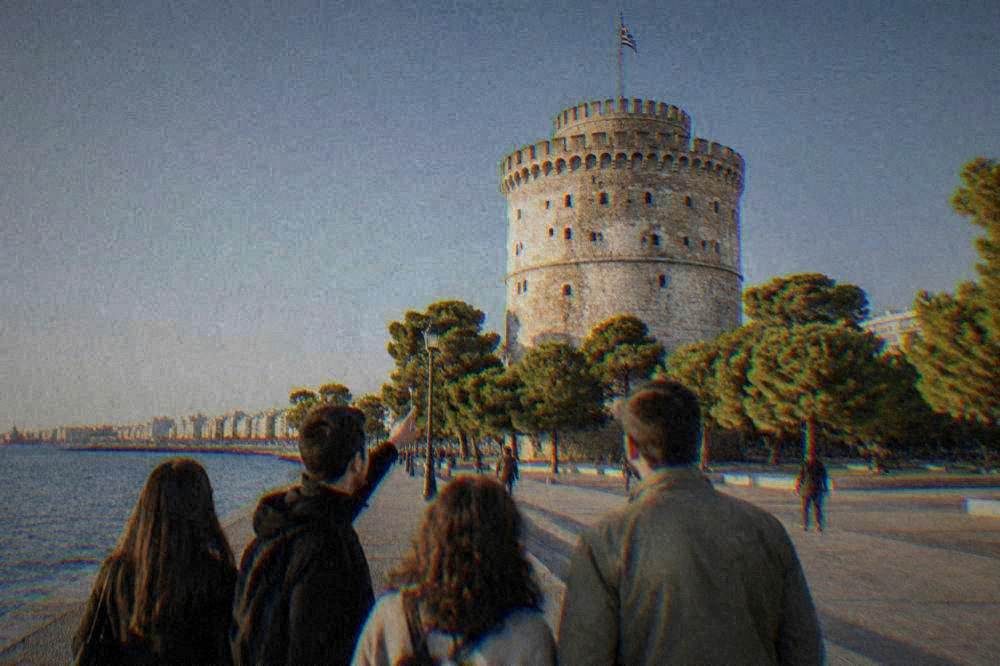
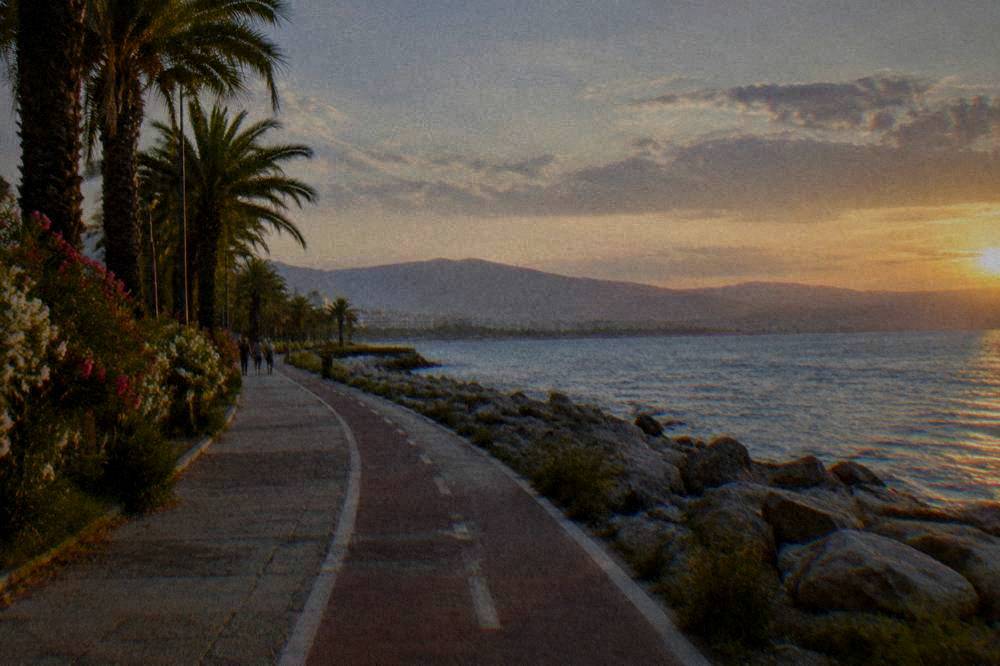
The Nea Paralia is Thessaloniki's seafront promenade on the Thermaic Gulf, a walk built around themes gardens, public art and views rather than swimming, running from the White Tower towards Kalamaria and the concert halls.
Short answer
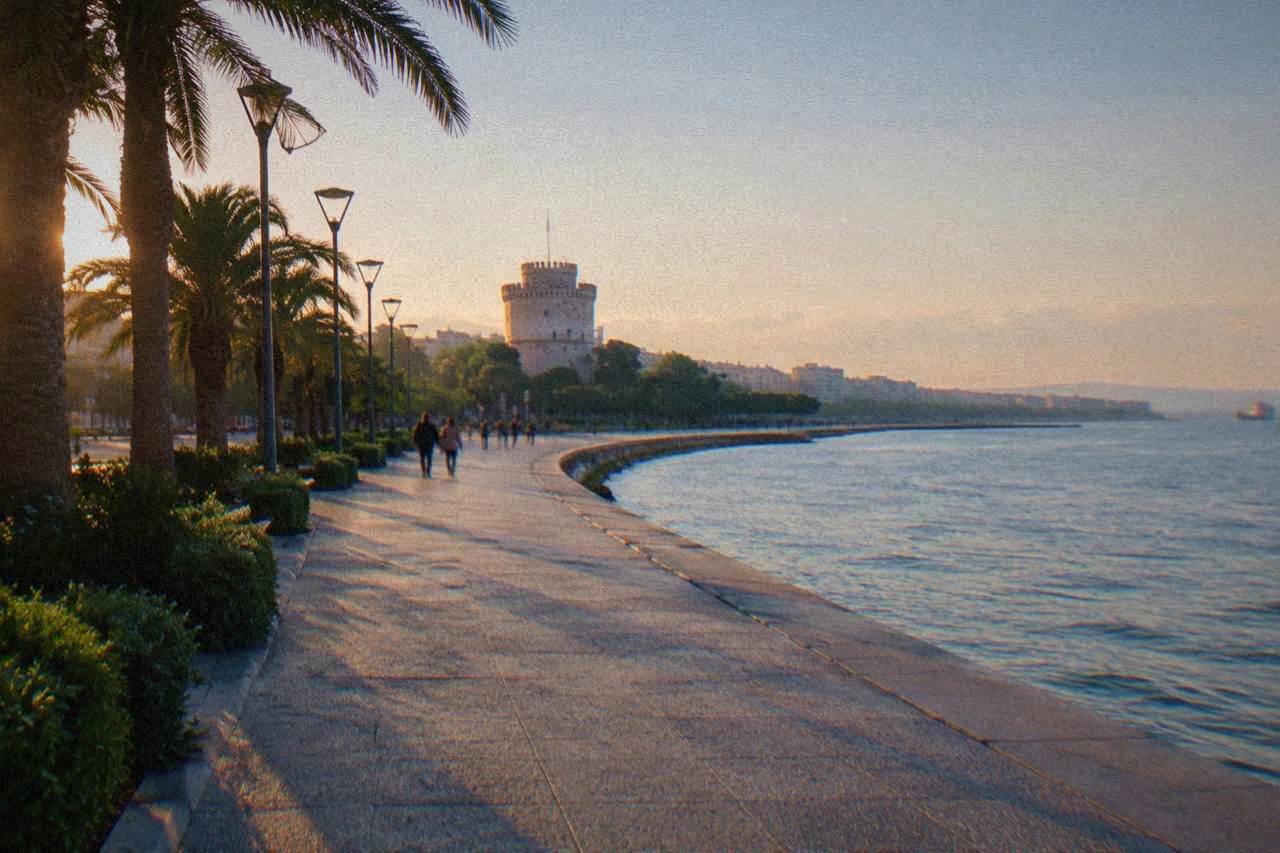
The Nea Paralia is a landscaped promenade along the Thermaic Gulf in Thessaloniki, Central Macedonia, starting at the White Tower and running southeast towards Kalamaria. It is for walking, cycling and views, not swimming: the nearest swimmable beaches are at Perea, Agia Triada or Epanomi.
Thessaloniki, the second city of Greece, sits on the north shore of the Thermaic Gulf in Central Macedonia, and its face to the sea is the Nea Paralia: a landscaped promenade that begins at the White Tower and runs southeast through a chain of theme gardens towards the suburb of Kalamaria and the city's concert halls. It is the walk the city is known for, a car-free ribbon of paths, benches, public art and plane trees, with Mount Olympus visible across the water on clear days. It is not a beach, and this page says plainly what it is instead: a promenade, with swimming a short drive away at Perea, Agia Triada or Epanomi.
What Is The Nea Paralia In Thessaloniki?
The Nea Paralia is Thessaloniki's seafront promenade on the Thermaic Gulf, a landscaped public walk that starts at the White Tower and runs southeast through a series of theme gardens towards Kalamaria and the Thessaloniki Concert Hall. It is a pedestrian and cycling space, free to enter and open at all hours, and it is the city's principal waterfront walk.
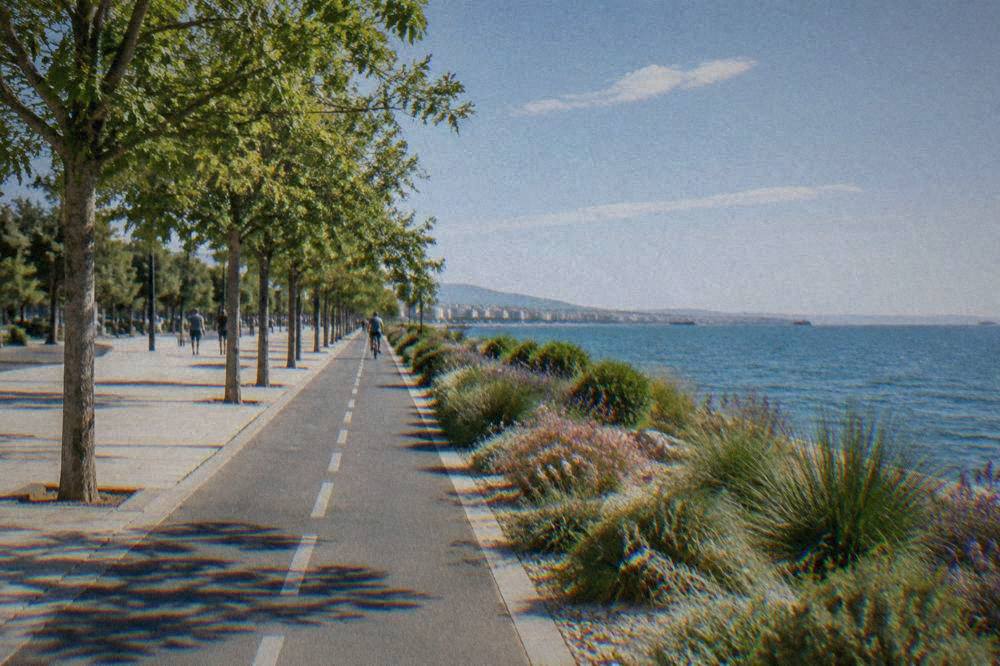
It was rebuilt in the 2010s as a designed landscape rather than a simple pavement: a broad walking path, a separate cycling lane, rows of trees and a sequence of themed gardens, each with its own planting scheme and character. The promenade connects the historic centre, whose fifteen UNESCO-listed Paleochristian and Byzantine monuments were inscribed in 1988, to the eastern suburbs along the water.
What the promenade does have, in plain and visible terms, is a chain of landmarks. From the White Tower, the walk passes the Royal Theatre, the umbrella installation, the Alexander the Great garden, the statue of the national poet and a marina area before reaching the concert hall quarter. Cyclists and pedestrians have separate lanes for the whole designed section, and the whole route is flat.
For orientation before arrival, the things to do in Thessaloniki overview places the promenade in the wider city, and a two days in Thessaloniki itinerary typically gives the waterfront an evening slot, when the sun sets over the gulf to the west.
What Can You See Along The Thessaloniki Waterfront Walk?
The walk strings together the White Tower at its start, the Royal Theatre, the Umbrellas installation, the Alexander the Great garden with its landmark statue, a shaded theme-garden sequence, a marina quarter and the Thessaloniki Concert Hall at its far end, with Mount Olympus visible across the gulf on clear days. Every one of these is free to see from the path.
The landmarks sit in a line, which makes the promenade easy to navigate without a map. The table below lists what the walk passes, in order from the city centre outwards, with what each one is.
| Landmark along the Nea Paralia | What it is |
|---|---|
| White Tower | The city's landmark Ottoman-era fortification, now a museum about Thessaloniki's history |
| Royal Theatre | Open-air theatre used in the summer festival season |
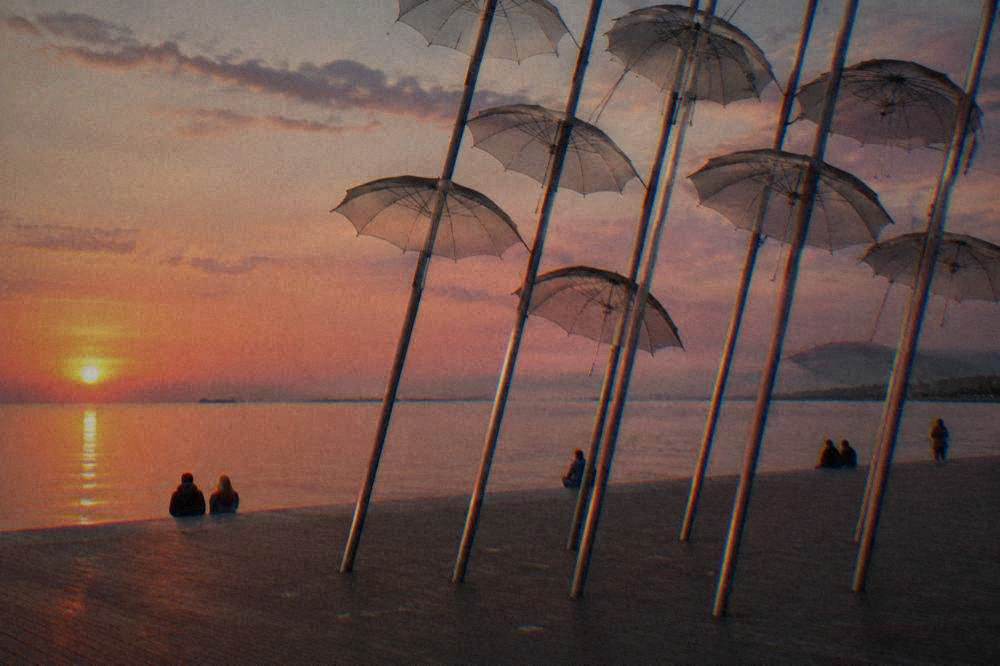
| Umbrellas installation | The photogenic sculpture of slanted umbrellas by the water's edge |
| Alexander the Great garden | Theme garden with a large equestrian statue of the Macedonian king |
| Theme gardens sequence | A chain of planted gardens, each with its own design theme |
| Marina quarter | Moored boats and waterfront blocks towards Kalamaria |
| Thessaloniki Concert Hall | The city's main concert venue complex at the eastern end |
The starting point deserves a proper visit rather than a walk-past. The White Tower's own visiting arrangements are covered on the White Tower page, and the museums near the promenade's western end, including the Archaeological Museum and the Museum of Byzantine Culture, sit a short walk inland.
A guided walk is one way to see the waterfront and the layers above it. The Thessaloniki Old Town Walking Tour, Mythology and Botany covers the old upper town of Ano Poli and its plant lore, a natural pairing with the designed gardens of the promenade below it.
Where Are The Famous Umbrellas Of Thessaloniki?
The Umbrellas, the tilted white sculpture installation that has become one of Thessaloniki's most photographed sights, stands at the water's edge on the Nea Paralia, a few minutes' walk southeast of the White Tower along the promenade. There is no ticket, no fence and no opening hour: the work sits in the open air on the public path.
The installation is the single most recognisable image of the modern waterfront, appearing on countless photographs of the city at sunset, when the umbrellas stand against the western sky over the gulf. Because it is public art on a public path, it can be visited at any hour, and it is at its most striking in the late afternoon and at dusk.
Photographers should know the practical geometry: the umbrellas face the open gulf, so the low western light of evening puts the sea behind them. Sunset times vary enormously through the year, and the climate section below gives the seasonal picture from the weather-station record.
Who Is The Alexander The Great Statue On The Thessaloniki Waterfront?
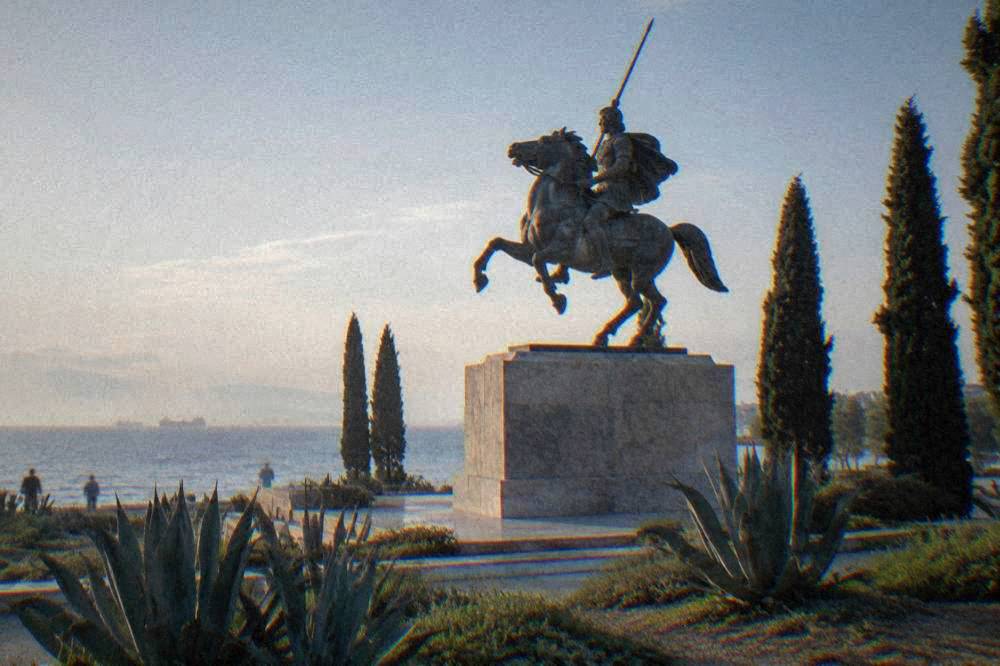
The large equestrian statue at the Alexander the Great garden on the Nea Paralia depicts Alexander the Great, the king of ancient Macedon, and it anchors one of the promenade's themed gardens a short walk southeast of the Umbrellas. It is a public monument, freely viewable from the path at any time.
Alexander connects the promenade to the region's ancient Macedonian hinterland. Thessaloniki was founded in 315 BC by Cassander, who named the city after his wife Thessalonike, a sister of Alexander, and the statue faces the gulf towards the Halkidiki peninsulas. The garden around it is one of the designed theme gardens of the rebuilt promenade, planted and laid out as a set piece rather than a leftover green space.
The statue is also a useful reminder of how close the ancient sites are. The Alexander the Great sites guide covers the ruins associated with the Macedonian kingdom, and the former capital Pella is about 43 minutes by road from Aristotelous Square, while the royal tombs at Vergina are about 62 minutes. These are the day trips that give the waterfront statue its context.
Can You Swim At The Nea Paralia In Thessaloniki?
No: the Nea Paralia is a promenade, not a swimming beach, and swimming at the city waterfront is not what the shoreline is for. Swimming around Thessaloniki is done at Perea, about 23 km and 28 minutes by road from Aristotelous Square, or at Agia Triada and Epanomi further around the gulf, all reachable by car or bus.
The distinction matters because plenty of older pages blur it. The city waterfront is a built promenade with no sand, no designated bathing area and no lifeguard service; the water in front of it is a working gulf shoreline with a port. The swimmable beaches are west and south of the centre, on the far side of the Thermaic Gulf's inner curve. The table below gives the road distances and free-flow drive times from Aristotelous Square. Other pages covering the same trip are gathered on Thessaloniki Travel Guide.
| Swimming destination | Distance by road | Drive time (free-flow) |
|---|---|---|
| Perea | 23.0 km | about 28 minutes |
| Epanomi | 28.8 km | about 36 minutes |
A seasonal water taxi between Thessaloniki and Perea is reported to run in summer for about 10 euro one way; that figure is reported rather than official, so confirm the schedule and price locally before relying on it.
For planning a day that mixes both, the beaches near Thessaloniki picture and the wider Thessaloniki and Halkidiki itinerary place Perea and the Halkidiki peninsulas in sequence. Kallithea on Kassandra is about 78 minutes by road, and Nikiti on Sithonia about 96 minutes.
Which Museums And Sights Sit Closest To The Thessaloniki Waterfront?
The White Tower stands at the promenade's western end, and the Archaeological Museum and the Museum of Byzantine Culture sit a short walk inland from it, with the Roman Rotunda and the Arch of Galerius a little further uphill in the historic centre. The museums' hours and the ticket prices in force from 1 April 2026 are listed below.
The ticket prices in force since 1 April are stated on the museums' own visiting pages: the White Tower costs 8 euro full and 4 euro reduced, and both major museums cost 10 euro full and 5 euro reduced. State museums are free on 6 March, 18 April, 18 May, the last weekend of September and 28 October, and free for EU citizens up to 25.
| Sight near the waterfront | 2026 admission (full / reduced) | Hours summary |
|---|---|---|
| White Tower | 8 / 4 euro | Summer daily 08:00-21:00; winter daily 08:30-15:30 |
| Archaeological Museum | 10 / 5 euro | Daily 09:00-17:00; closed Tuesdays from 1 November to 31 March |
| Museum of Byzantine Culture | 10 / 5 euro | Summer daily 08:00-20:00; winter Mon, Wed-Sun 08:30-15:30 |
| Rotunda | check the current price on the site's own ticket page before booking | Reported summer hours around 08:00-20:00 |
| Arch of Galerius | free to view | Open-air monument on Egnatia street |
The Rotunda and the Arch of Galerius belong to the Roman Galerian complex a few blocks inland, and the Rotunda page covers what is stated about it.
When Is The Best Time Of Year To Walk The Thessaloniki Waterfront?
The promenade is walkable all year, but the weather-station record shows the comfortable walking months are April, May, September and October, with mean daily highs of 19.1 C, 24.6 C, 27.1 C and 21.2 C respectively, while July and August average 31.7 C and 31.4 C highs, which pushes walking to the morning and evening.
The figures below are from the HNMS Thessaloniki Mikra station, 1959 to 2010, the only climate series printed on this site. They are long-run station means, not a forecast, and they describe the air temperature on the promenade rather than the sea.
| Month | Mean daily high C | Mean daily low C | Rain mm |
|---|---|---|---|
| March | 14.3 | 4.7 | 37.9 |
| April | 19.1 | 7.9 | 36.1 |
| May | 24.6 | 12.6 | 44.2 |
| June | 29.4 | 17.0 | 29.8 |
| July | 31.7 | 19.3 | 23.8 |
| August | 31.4 | 19.1 | 19.3 |
| September | 27.1 | 15.4 | 29.8 |
| October | 21.2 | 11.3 | 43.0 |
Rain tells a similar story: December has the highest monthly total in the record at 55.1 mm and August the lowest at 19.3 mm, with the warm half of the year consistently drier than the cold half. Winter walks are entirely possible, with January mean highs of 9.3 C, but the record shows 11.5 rain days in January against 5.1 in August.
The autumn window carries an extra draw: the Thessaloniki International Film Festival ran 5 to 15 November in its 2026 edition, and the Dimitria festival was reported for 1 to 26 October 2026, both of which fill the city, and the promenade's evening hours, with life. Check the current year's programme before travelling for either.
Which Tours And Tickets Pair Well With The Thessaloniki Waterfront?
Three kinds of bookable product pair naturally with the promenade: guided walking tours that include the seafront and the upper town, food tours that start or end near the central markets, and city-attraction tickets such as the Museum of Illusions near the waterfront quarter. Each is described below by what it covers, with prices and ratings on the operator's live listing.
The related pick for this page is the old town mythology and botany walk already mentioned above: it climbs into Ano Poli, whose Byzantine walls and the Heptapyrgion fortress, a prison until 1989, look down over the whole waterfront line. A second option is a market food walk: the Modiano Market and Kapani Market sit inland of Aristotelous Square, and a tasting tour there is the standard wet-weather counterpart to a promenade day.
The Museum of Illusions ticket is the family-friendly filler: an indoor attraction a short walk from the promenade, bookable without fixed timing, which suits a hot midday or a rain day.
The market walk above is the third pairing. Thessaloniki's food reputation is municipal policy as much as habit: the city runs a dedicated gastronomy programme within the UNESCO Creative Cities framework. Eating well before or after a long waterfront walk is not a recommendation so much as the local structure of the day.
How Does The Nea Paralia Connect To The Rest Of Thessaloniki?
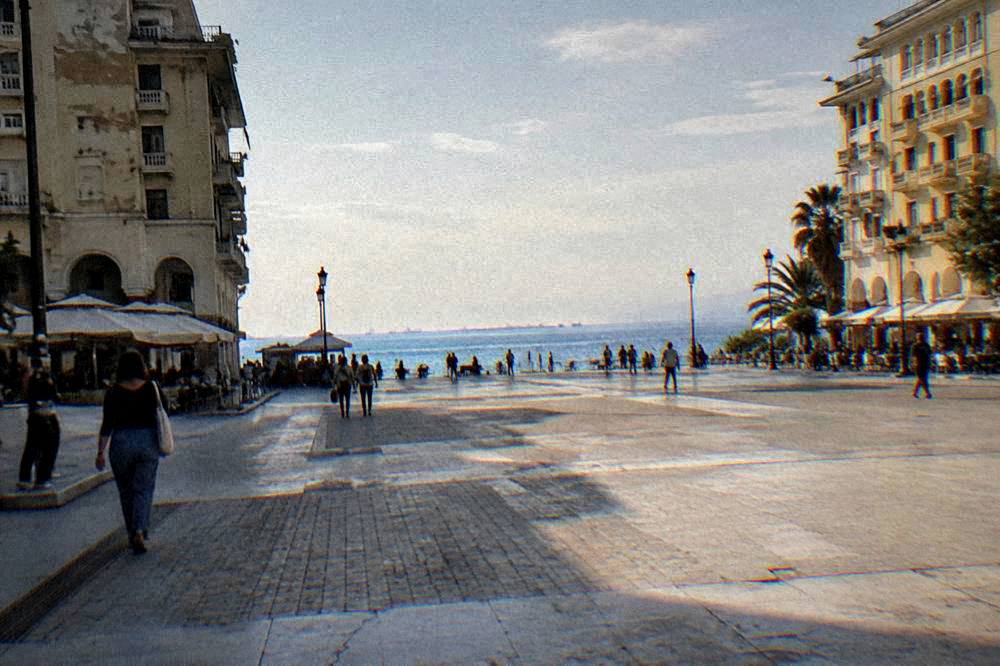
The promenade's western end meets the historic centre at the White Tower and Aristotelous Square, the city's central square laid out under the post-1917 reconstruction plan, while its eastern end reaches towards Kalamaria, and the whole line is served by the Thessaloniki Metro, open since November 2024 with the Kalamaria extension inaugurated on 27 August 2026.
That metro fact is worth stating plainly because outdated guides still say the city has no metro or that it opens soon. Neither is true. Line 1 runs from 05:15 to 00:30 Sunday to Thursday and 05:15 to 02:00 Friday and Saturday, a basic ticket costs 0.60 euro and a 24-hour daily ticket 2.50 euro, per the Thessaloniki Metro's own ticket page. The Kalamaria branch puts five more stations within reach of the promenade's eastern half, including Mikra.
For day trips that begin or end on the waterfront, the road times from Aristotelous Square are set out below.
| Day trip destination | Distance by road | Drive time (free-flow) |
|---|---|---|
| Pella | 45.7 km | about 43 minutes |
| Vergina | 68.0 km | about 62 minutes |
| Dion | 90.1 km | about 67 minutes |
| Litochoro (Mount Olympus) | 90.7 km | about 67 minutes |
| Edessa | 90.3 km | about 82 minutes |
| Kallithea (Kassandra) | 86.2 km | about 78 minutes |
| Nikiti (Sithonia) | 97.2 km | about 96 minutes |
| Meteora (Kalambaka) | 227.5 km | about 154 minutes |
Meteora is the one to plan honestly: about 228 km and roughly two and a half hours each way by road makes it a full day, not a half day. The drive times are free-flow estimates, with no traffic, parking or stops included, so treat them as floors rather than promises.
What Should You Know Before Walking The Thessaloniki Waterfront?
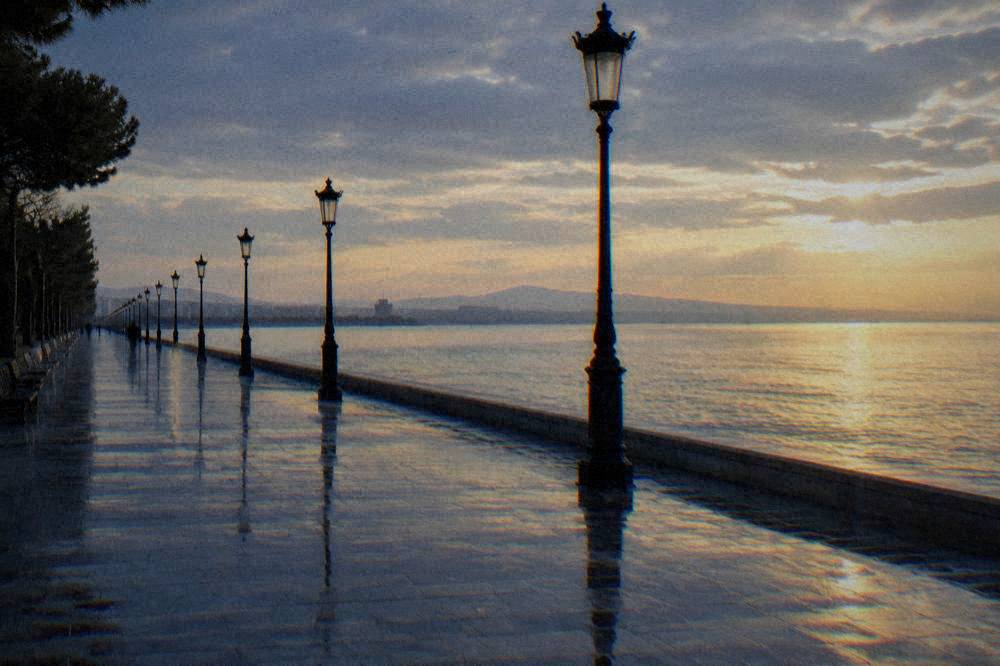
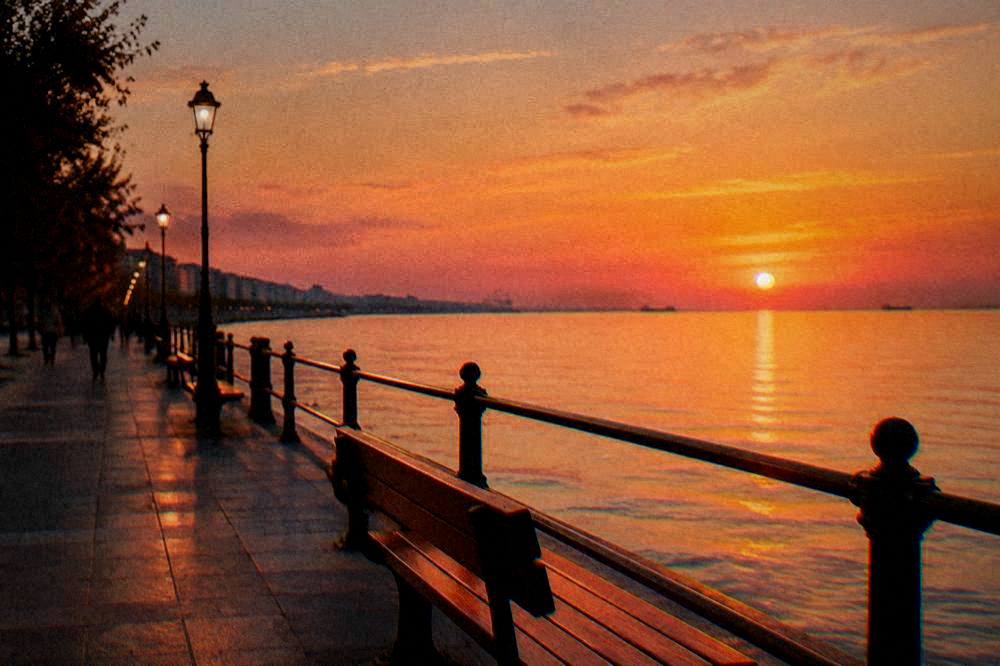
Bring water in summer, expect the midday heat of July and August to push everyone to the shaded garden sections, keep swimming for Perea or Epanomi, and treat the promenade as an evening place as much as a morning one: the sunset over the Thermaic Gulf, behind the Umbrellas, is the reason the walk has its reputation.
The emergency number in Greece is 112. Greece is in the Schengen area and uses the euro. Accommodation anywhere in the city collects the Greek climate resilience fee per room per night, higher from April to October; rates are collected locally at check-in. The tourist information centre is at Aristotelous Square, at the promenade's western approach, though its phone line is a reported figure: confirm details locally.
Two more honest notes. And the city's events calendar shifts: the Thessaloniki International Fair ran 5 to 13 September in its 2026 edition and the film festival follows in November, so central hotels and the western promenade are busier in those windows.
The White Tower at the walk's start is the one paid sight on the route itself, at 8 euro full and 4 euro reduced since 1 April 2026, per the Museum of Byzantine Culture's own visiting page, which administers it. Beyond that, the promenade is free, open and, at dusk, exactly what the photographs promise: a city walking beside its own sea.
Common Questions About The Thessaloniki Waterfront
Is the Nea Paralia a beach?
No. The Nea Paralia is a landscaped promenade on the Thermaic Gulf, built for walking and cycling, with no sand or designated bathing. Swimming around Thessaloniki is done at Perea, about 28 minutes by road, or at Agia Triada and Epanomi.
Where does the Nea Paralia start and end?
The designed promenade starts at the White Tower and runs southeast through the theme gardens towards the marina quarter, the suburb of Kalamaria and the Thessaloniki Concert Hall at its eastern end.
Is the Nea Paralia free?
Yes, the promenade, the Umbrellas installation and the Alexander the Great garden are all public space, free and open at all hours. The only paid sight on the route itself is the White Tower, at 8 euro full and 4 euro reduced since 1 April 2026.
Can you cycle on the Nea Paralia?
Yes, the rebuilt promenade has a separate cycling lane alongside the walking path for its designed length. Guided bike tours of the city also use the seafront line; check the operator's live listing for current availability.
When is the best time of day to walk the Thessaloniki waterfront?
Evening. The Umbrellas and the Alexander the Great statue face west over the gulf, and the sunset behind them is the walk's signature view. In July and August, when the HNMS Thessaloniki Mikra station record shows mean highs above 31 C, morning and evening are also the practical choices.
How do you get to the Nea Paralia by metro?
The metro is open: Line 1 began running in November 2024 and the Kalamaria extension was inaugurated on 27 August 2026. A basic ticket costs 0.60 euro and a 24-hour daily ticket 2.50 euro, per the Thessaloniki Metro's ticket page, and the service runs from 05:15 to 00:30 Sunday to Thursday and to 02:00 on Friday and Saturday nights.