Arch Of Galerius: The Kamara On Egnatia Street
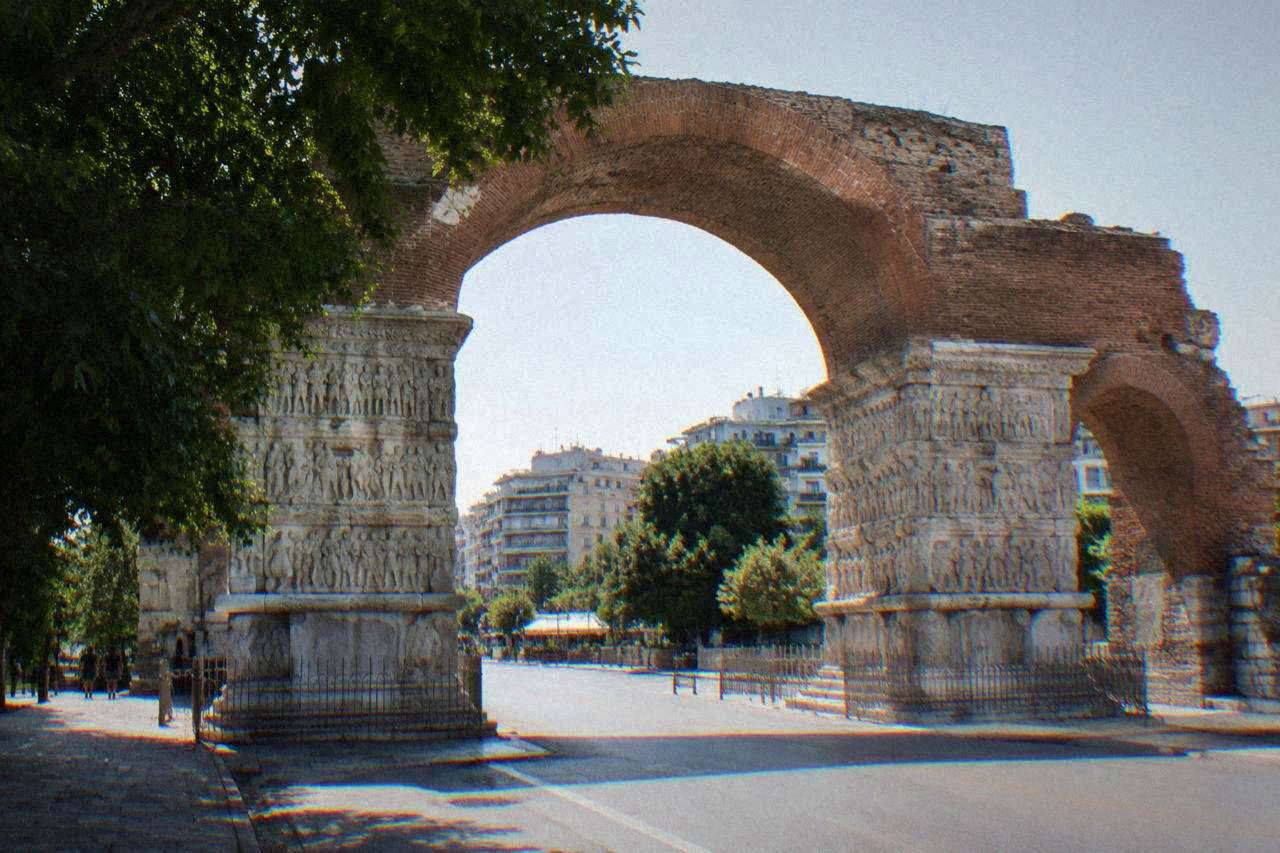
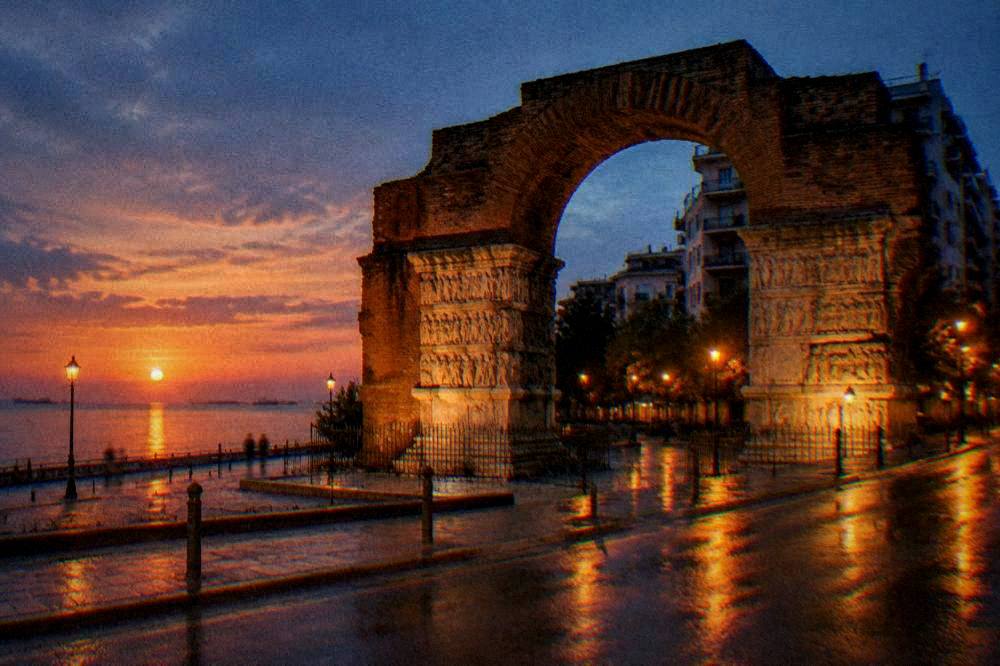
The Arch of Galerius, the Kamara to locals, is the open-air centrepiece of a Roman emperor's building programme, standing free to view in the middle of Thessaloniki.
Short answer
The Arch of Galerius in Thessaloniki, known locally as the Kamara, is a late Roman triumphal monument on Egnatia Street. It is open-air, free to view at any hour, and forms part of the Galerian complex together with the Rotunda and the Palace of Galerius.
The Arch of Galerius stands in the middle of Egnatia Street in Thessaloniki, the second city of Greece, on the Thermaic Gulf in Central Macedonia. Locals call it the Kamara, the arch, and it is one of the few Roman monuments anywhere that still carries traffic and pedestrians beneath its piers rather than sitting behind a fence. It is open-air, free to view at any hour, and it anchors a line of imperial building that runs from the Rotunda a few hundred metres to the northeast to the Palace of Galerius to the southwest. This guide lays out what the carved marble panels actually show, how to reach the arch by the Thessaloniki Metro, how the monument fits the rest of the Galerian complex, and what to pair it with on foot, drawing on the Thessaloniki Travel Guide site's collection of sight-by-sight pages.
What Is The Arch Of Galerius In Thessaloniki?
The Arch of Galerius is a late Roman triumphal arch in central Thessaloniki, built as part of the emperor Galerius's palace complex and standing today as an open-air street monument on Egnatia, free to view at any hour. It carries carved marble reliefs that celebrate Galerius's campaign against the Persians, and its local name, the Kamara, is the everyday Greek word for an arch.
The arch belonged to a much larger scheme. When Galerius, one of the four rulers of the Tetrarchy, made Thessaloniki his base, he built a palace quarter at the eastern edge of the city: a palace, a hippodrome, a triumphal arch and the great round structure now called the Rotunda. The municipality's monument pages place all of these on one axis, and the arch sat at the junction where the processional way met the route to the palace.
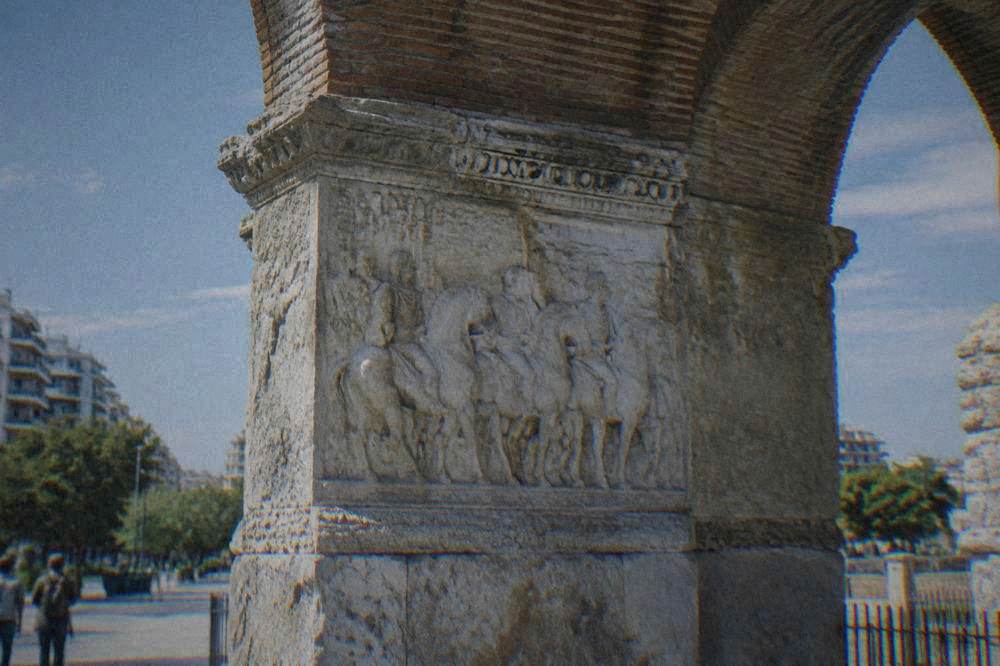
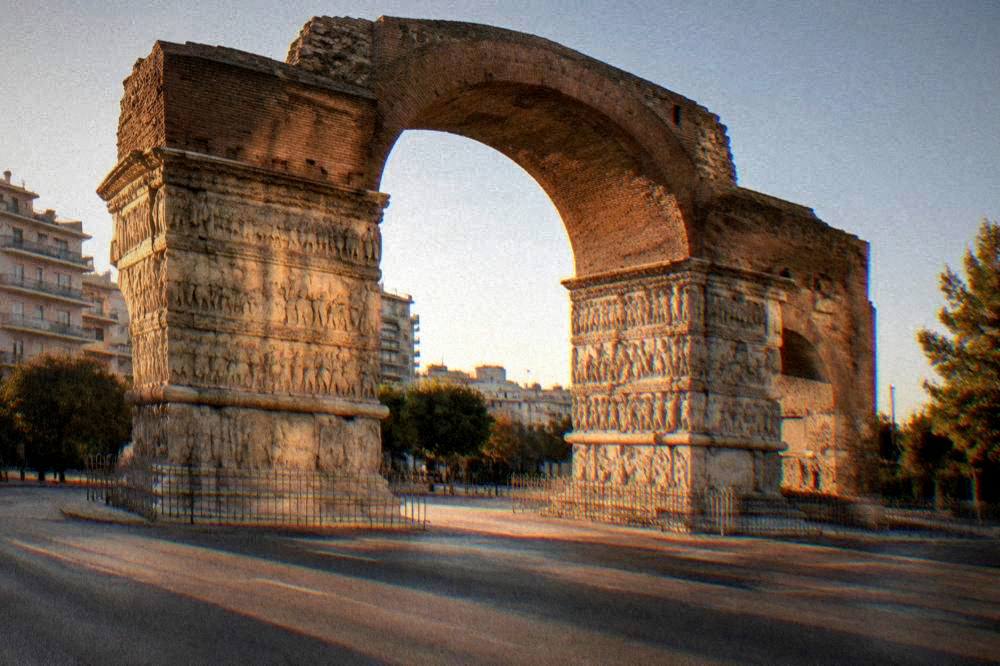
What is settled is the scene on the marble. The carved piers show Galerius's campaign against the Persian king Narses, with battle scenes, submissions and the imperial family in procession. Weathering and later rebuilding have reduced the arch from its original form, and what stands today is a fragment: two main piers, of an original set, carrying reliefs on their faces and once topped by a brick vault of which part survives. Visitors read the reliefs at street level, no ticket, no barrier, only the noise of Egnatia.
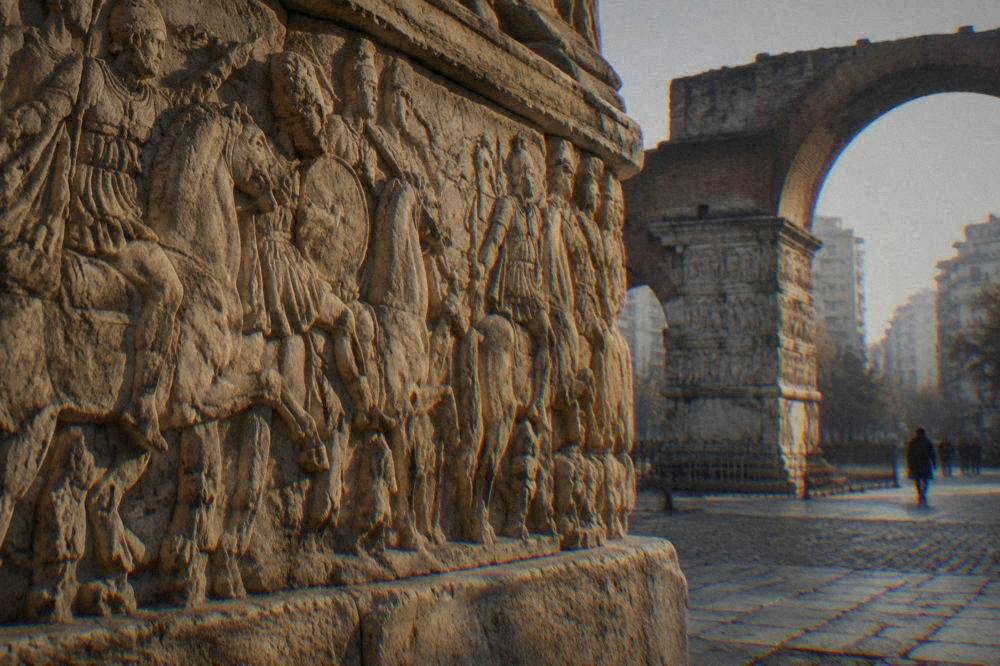
The reliefs divide by theme, and knowing what each face shows turns a passing glance into a reading:
| Relief location | Subject | What to look for |
|---|---|---|
| Eastern pier, north face | Galerius on campaign against the Persians | The emperor on horseback, ranks of soldiers |
| Eastern pier, south face | Battle and pursuit scenes | Fallen enemies beneath the horses |
| Western pier faces | Imperial procession and family | Court figures, diadem details |
| Central passage reliefs | Submission of enemies | Kneeling figures before the emperor |
| Vault fragments | Ceiling ornament | Remaining brick and stone of the arch's crown |
Because the monument is street furniture, lighting matters. Late afternoon light rakes across the piers and lifts the relief depth, which is why the Kamara is a standard stop on the city's guided walks rather than a morning museum visit. The page on walking the city's sights covers how the arch sits on a natural walking line.
Where Is The Arch Of Galerius And How Do You Get There?
The Arch of Galerius stands on Egnatia Street at the junction with Dimitriou Gounari, in the eastern half of central Thessaloniki, about a 10-minute walk from Aristotelous Square and a few minutes from the Rotunda. The nearest metro link is the Thessaloniki Metro, whose Line 1 has run since November 2024, with a basic ticket of 0.60 euro or a daily ticket of 2.50 euro.
The Thessaloniki Metro changed how visitors reach this part of the city. Line 1 opened in November 2024 from the New Railway Station to Nea Elvetia, and the Kalamaria extension, inaugurated on 27 August 2026, added five more stations out to Mikra. The metro's ticket page states the basic fare of 0.60 euro for one journey and 2.50 euro for a 24-hour daily ticket, and the metro runs 05:15 to 00:30 Sunday to Thursday and 05:15 to 02:00 Friday and Saturday. From the Ephoria or Venizelou area the arch is a short walk up Egnatia, and the city's street grid makes the Rotunda, the arch and the palace an easy straight-line stroll.
Options for reaching the arch:
| Way of arriving | What it involves | Figure |
|---|---|---|
| Metro Line 1 | New Railway Station to Nea Elvetia, Kalamaria branch to Mikra since 27 August 2026 | 0.60 euro single, 2.50 euro daily |
| On foot from Aristotelous Square | Level walk east along Egnatia | About 10 minutes |
| Hop-on hop-off sightseeing bus | A stop-based circuit covering the main sights | Details and prices on the operator's live listing |
| Airport transfer then metro | Airport bus X1 to the KTEL terminal, then metro or taxi onward | Airport bus fare reported at about 2 euro |
Drivers should note that Egnatia is a major traffic artery, so the arch is viewed from the pavement and the central reservation crossings, not from a parked car. The page on getting around Thessaloniki works through the full set of options, and the airport-to-centre guide covers the arrival leg.
What Can You See On The Arch Of Galerius Today?
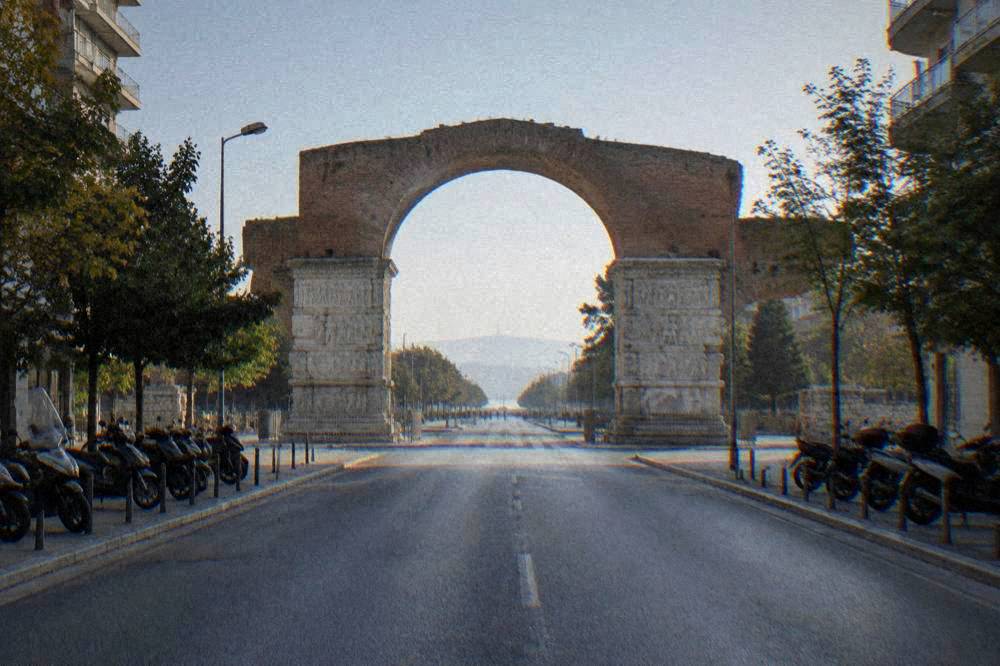
Today you can see two massive piers with carved marble battle and procession reliefs, the surviving springing of the brick vault, and a cut-down section of the arch's original length, all viewed from street level for free. The reliefs glorify Galerius's victory over the Persians, and the arch's reduced state is itself part of the story, since later centuries quarried and rebuilt around it.
The arch was not always this short. The form visitors see is a preserved central portion of what was a longer structure, and the masonry shows a mix of the original construction and later repairs. The marble panels are bagged into the piers rather than spread across a full attic, which makes Thessaloniki's arch read more like a carved pier monument than the single-opening triumphal arches of Rome. Each face rewards a slow circuit: soldiers, horses, captives and the imperial entourage are packed together at a scale meant to be legible from a moving procession.
A guided walk adds the reading. The Thessaloniki Walking Tour: Explore Top Sights & Hidden Gems takes in the arch alongside the Rotunda and the other downtown landmarks, and its details and prices are on the operator's live listing. Between the piers, look for these carved elements:
| Element on the arch | Where it sits | Why it matters |
|---|---|---|
| Equestrian battle relief | East pier, main face | The clearest campaign scene, Galerius on horseback |
| Submission group | Central pier band | Captives presenting, the political point of the monument |
| Imperial procession | West pier | Court hierarchy carved in rank order |
| Vault springing | Top of the piers | The surviving start of the arch's brick vault |
| Later repair masonry | Lower pier courses | Visible joins from post-Roman rebuilding |
Nothing here is behind glass. The arch stands in lived-in street space, which is exactly why the reliefs have weathered, and why the city has put protective railings at ground level only. Photography is unrestricted from the pavement.
How Does The Arch Connect To The Rotunda And The Palace Of Galerius?
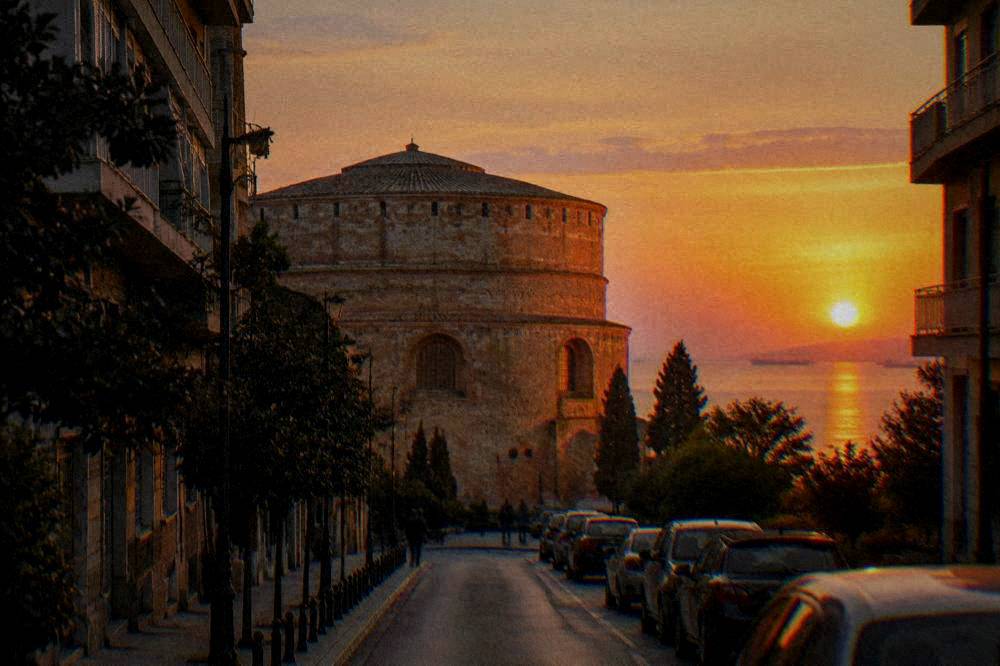
The Arch of Galerius was the hinge of the Galerian complex: the Rotunda stands about 125 metres to its northeast, the Palace of Galerius lies a few hundred metres to the southwest along Dimitriou Gounari, and the arch sat where a processional route linked the two. Walking the three in a line, Rotunda, arch, palace, is the clearest way to grasp the scale of Galerius's Thessaloniki.
The Rotunda is the great round building at the top of the line, and its own page covers the interior mosaics and the debates about its original purpose, which the sources do not settle. The palace at the other end preserves excavated halls and the Apsidal Hall, reachable along Dimitriou Gounari street, which follows the line of the old hippodrome. The arch stood between them, marking the crossing of the processional way with Egnatia. The municipality's monument pages present the three as one complex, and that framing is the one to carry while walking.
| Piece of the Galerian complex | Position relative to the arch | What survives |
|---|---|---|
| Rotunda | Northeast, a few minutes on foot | Massive round shell, mosaic vaults |
| Arch of Galerius | The hinge on Egnatia | Two carved piers, vault fragments |
| Palace of Galerius | Southwest along Dimitriou Gounari | Excavated halls including the Apsidal Hall |
| Hippodrome | Along the palace line, now built over | Trace in the street plan only |
Prices for the Rotunda, the palace and the arch's complex are not printed on the official pages this site uses, so check the current price on each site's own ticket page before booking or setting out. The arch itself is free. For the deep context on the whole set, see the guides to the Rotunda and the Palace of Galerius, and the longer city walking route that strings them together.
What Is The History Behind The Kamara And Roman Thessaloniki?
Thessaloniki was founded in 315 BC by Cassander and named for his wife Thessalonike, a sister of Alexander the Great, and under Roman rule it grew into a provincial capital important enough for Galerius to build his palace quarter here. The arch belongs to that late Roman moment, more than six centuries after the city's founding, and the UNESCO listing that now protects the city's early Christian and Byzantine monuments came in 1988.
The city's Roman weight came from geography. Thessaloniki sat on the Via Egnatia, the road that linked the Adriatic to the Hellespont, and that is why the modern street through the arch carries the old name. When the Tetrarchy divided imperial rule, Galerius chose Thessaloniki as his residence and raised the complex this page covers. Later the city passed under Byzantine rule, was taken by the Ottomans in 1430, was liberated by the Greek army on 26 October 1912, and grew into the second city of modern Greece.
A short timeline of the periods the arch has watched:
| Year | Event |
|---|---|
| 315 BC | Cassander founds the city, naming it for Thessalonike |
| Roman era | Galerius builds the palace complex with the arch and Rotunda |
| 1430 | Ottoman conquest of the city |
| 1912 | Liberation by the Greek army on 26 October |
| 1988 | UNESCO inscription of fifteen Paleochristian and Byzantine monuments |
| 2024 | Metro Line 1 opens in November, reshaping access to Egnatia |
The arch's own construction date is not confirmed in the official sources, so this guide leaves it out rather than repeating a number found only in second-hand pages. The broader story, including the Great Fire of 1917 and the 1978 earthquake, is on the city history page.
When Is The Best Time Of Day To Visit The Arch Of Galerius?
There is no opening hour and no closing hour for the Arch of Galerius, because it is an open-air street monument on Egnatia, viewable at any time and always free. What changes through the day is light and traffic: low morning or late-afternoon sun gives the carved reliefs their strongest depth, while midday flattens them and puts the street at its busiest.
The climate record for the city comes from the HNMS Thessaloniki Mikra station, 1959 to 2010, and it frames the practical question. Summer afternoons average a mean high of 31.7 C in July and 31.4 C in August, which pushes sensible viewing toward morning or evening in those months. October, when the city fills for the Dimitria festival and the Night Half Marathon, averages a mean high of 21.2 C and mean low of 11.3 C, with about 43 mm of rain across the month.
| Month | Mean high C | Mean low C | Rain mm |
|---|---|---|---|
| April | 19.1 | 7.9 | 36.1 |
| July | 31.7 | 19.3 | 23.8 |
| September | 27.1 | 15.4 | 29.8 |
| October | 21.2 | 11.3 | 43.0 |
| December | 10.9 | 3.2 | 55.1 |
Rain is not a barrier here the way it is for an exposed hill site: the arch is a five-minute dash from cafe cover on Dimitriou Gounari, and the page on Thessaloniki in the rain builds a whole day around exactly this kind of covered-and-quick sight. For photographers, the hour before sunset is the reliable slot, and the nearby viewpoint options are covered in the guide to the city's viewpoints.
What Sits Near The Arch Of Galerius?
Within ten minutes on foot of the Arch of Galerius stand the Rotunda, the excavated Palace of Galerius, the Church of Saint Demetrius, the Church of the Panagia Acheiropoietos, the Roman Agora site and the markets and squares of the city centre, so the arch works best as a pivot for a walking loop rather than a lone stop. The nearest food streets run down toward the Modiano Market and the Ladadika quarter beyond it.
The density is unusual. Egnatia is the spine, and almost every headline sight of the historic centre hangs off it or one street off it. The Church of Saint Demetrius, the city's patron saint's church, lies west along Egnatia; the Panagia Acheiropoietos and the Roman Agora sit between the arch and Aristotelous Square; the White Tower and the Nea Paralia promenade open out at the seafront, about 15 minutes on foot.
| Nearby sight | Direction from the arch | Notes |
|---|---|---|
| Rotunda | Northeast, few minutes | Round Roman building, mosaics |
| Palace of Galerius | Southwest on Gounari | Excavated halls, Apsidal Hall |
| Church of Saint Demetrius | West on Egnatia | Working church, free entry outside services |
| Roman Agora | West toward the square | Ancient forum site |
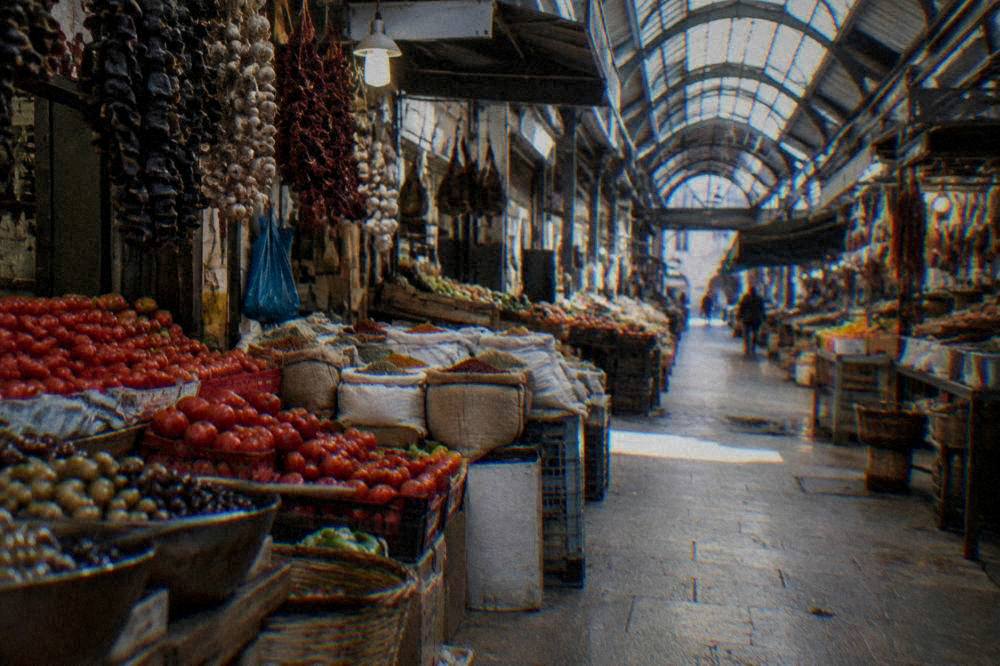
| Modiano Market | Southwest, downhill | Covered food market |
| White Tower and Nea Paralia | South to the seafront | Landmark tower and promenade |
Ticketed neighbours print their own prices, and only those confirmed on official pages belong here: the White Tower is 8 euro full and 4 euro reduced from 1 April 2026, per the Museum of Byzantine Culture's visiting page, and the Archaeological Museum and the Museum of Byzantine Culture are each 10 euro full and 5 euro reduced, with hours on their own pages. State museums are free on 6 March, 18 April, 18 May, the last weekend of September and 28 October. The White Tower page and the museum overview carry the details.
Is The Arch Of Galerius Free And Accessible To Everyone?
Yes, the Arch of Galerius is completely free to view, being an open-air monument standing in public street space on Egnatia, with no ticket desk, no gate and no closing time. Viewers reach the piers from the surrounding pavements and street crossings, and the site claims nothing about step-free provisions, lifts or ramps, which this site does not state for any Thessaloniki sight.
That free-and-open status makes the arch one of the anchor stops on the budget circuit, and the guide to free things to do in Thessaloniki places it alongside the churches and the promenade. The choice for visitors is not whether to pay for the arch but whether to pay for interpretation, and that is where guided options earn their keep.
Two other formats suit the arch well. The Thessaloniki: City Sightseeing Hop-On Hop-Off Bus Tour runs a stop-based circuit with multilingual audio, useful on a short stay or a hot afternoon, with details on the operator's live listing. And since the Kamara sits a short walk from the Modiano and Kapani markets, the Thessaloniki Street Food Tour with a Local Guide pairs the monument with the food streets around it; its prices and times are on the operator's listing.
Common Questions About The Arch Of Galerius
Is the Arch of Galerius free to visit?
Yes. The arch is an open-air street monument on Egnatia in Thessaloniki, free to view at any hour with no ticket or gate.
What is the Kamara in Thessaloniki?
The Kamara is the local name for the Arch of Galerius, the late Roman triumphal arch on Egnatia Street, built as part of Galerius's palace complex and carved with reliefs of his Persian campaign.
How do I get to the Arch of Galerius?
The arch stands at Egnatia and Dimitriou Gounari, about a 10-minute walk east of Aristotelous Square. The Thessaloniki Metro's Line 1 serves the centre, with a 0.60 euro single ticket and a 2.50 euro daily ticket per the metro's ticket page.
What do the reliefs on the Arch of Galerius show?
The carved marble panels show Galerius's campaign against the Persian king Narses: cavalry battles, the submission of enemies and the imperial family in procession.
How far is the Rotunda from the Arch of Galerius?
The Rotunda stands a few minutes' walk northeast of the arch, at the top of the same Galerian complex axis that runs down to the Palace of Galerius.
When was the Arch of Galerius built?
The arch belongs to the building programme of the emperor Galerius in the late Roman period. The exact construction years are not settled in the official sources, so this guide does not print a date.
The Kamara rewards exactly the kind of slow, informed walk that Thessaloniki makes easy: off the metro, along Egnatia, through the piers, and on to the Rotunda before the light goes. Pair it with the palace site in the same hour and the emperor's quarter reads as one coherent place, which is how it was built to be read.