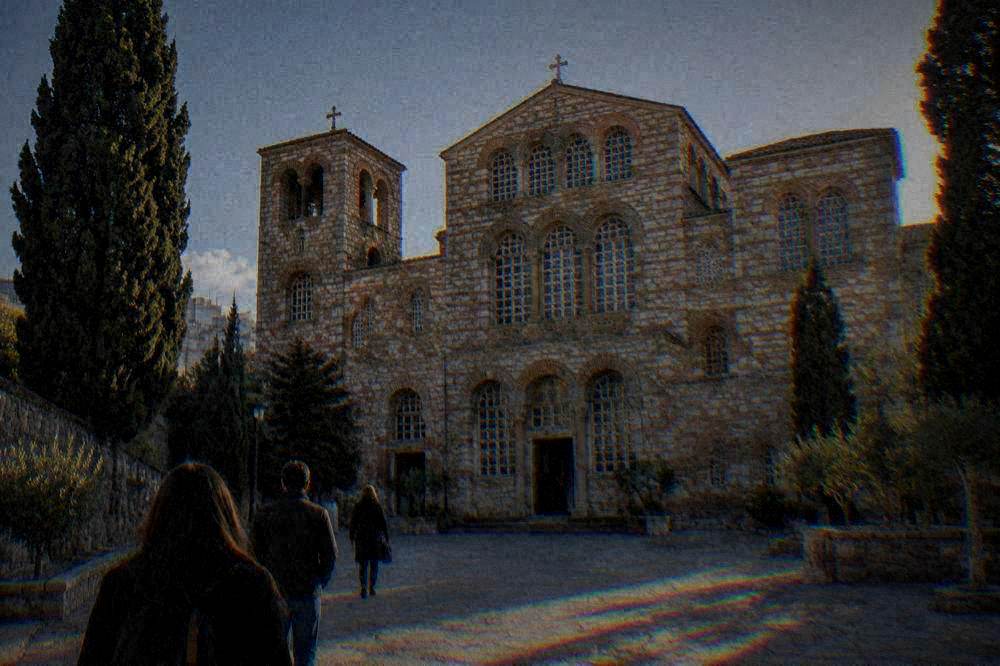
Galerius Palace: The Ruins Of A Roman Emperor's Residence
The Palace of Galerius in Thessaloniki is the ruined seat of a Roman emperor, sprawled across the modern city centre between Navarinou Square and the Rotunda, free to walk around at street level and a short metro ride from anywhere on Line 1.
Short answer
The Palace of Galerius in Thessaloniki is the surviving core of a vast Roman imperial residence. Its ruins lie around Navarinou Square, a few minutes on foot from the Arch of Galerius and the Rotunda, and the open-air parts can be viewed from the street at any time. Reported summer opening hours for the enclosed halls run to about 20:00, and no ticket price for the complex carries a confirmed figure, so confirm locally before a timed visit.
Thessaloniki, the second city of Greece on the Thermaic Gulf in Central Macedonia, hides a Roman imperial palace under its streets. The Palace of Galerius, built for the emperor Galerius, once covered a huge rectangular block at the eastern edge of the historic centre, arranged around a colonnaded central avenue that the modern city has traced with its own roads. Today the ruins sit in plain view: a sunken stretch of the ancient boulevard on Dimitriou Gounari street, vaulted substructures off Navarinou Square, and the golden-hued shell of the arch and the Rotunda anchoring either end. This page from the Thessaloniki Travel Guide sets out what the palace is, what you can actually see, how to get there on the city's open metro, and how the reported visiting arrangements work.
What Is The Palace Of Galerius In Thessaloniki?
The Palace of Galerius is the surviving ruin of a Roman imperial residence built in a later period by the emperor Galerius, one of the four tetrarchs who ruled the later Roman empire in divisions, and it served as his seat when Thessaloniki functioned effectively as an imperial capital.
What stands today is the lower core of the complex, laid out along a colonnaded central street that ran from the triumphal Arch of Galerius toward the Rotunda, and the ruins sit in the open fabric of the modern city around Navarinou Square.
Galerius belonged to the tetrarchy, the system of shared rule created under Diocletian in which two senior emperors and two juniors governed different parts of the empire. Thessaloniki, a city founded in 315 BC by Cassander and named for his wife Thessalonike, sat on the Via Egnatia, the great Roman road built between 146 and 120 BC that linked the Adriatic to the Aegean, and Galerius chose it as the base for the eastern part of his responsibilities. The municipal history pages record that his building programme gave the city a palace, a hippodrome and a triumphal arch, with the Rotunda associated with the same era.
The scale is the thing that surprises. The palace was not a single building but a district: reception halls, courtyards, service corridors and an octagonal throne room, all threaded along the processional way that the emperor would ride down from the arch. The hippodrome, the racing track that ran parallel to the palace, survives faintly in the long straight line of modern Dimitriou Gounari street. Nothing of the seating remains, but the street still runs exactly where the races once did, which is one of the clearest cases anywhere in Greece of a modern city block inheriting a Roman footprint.
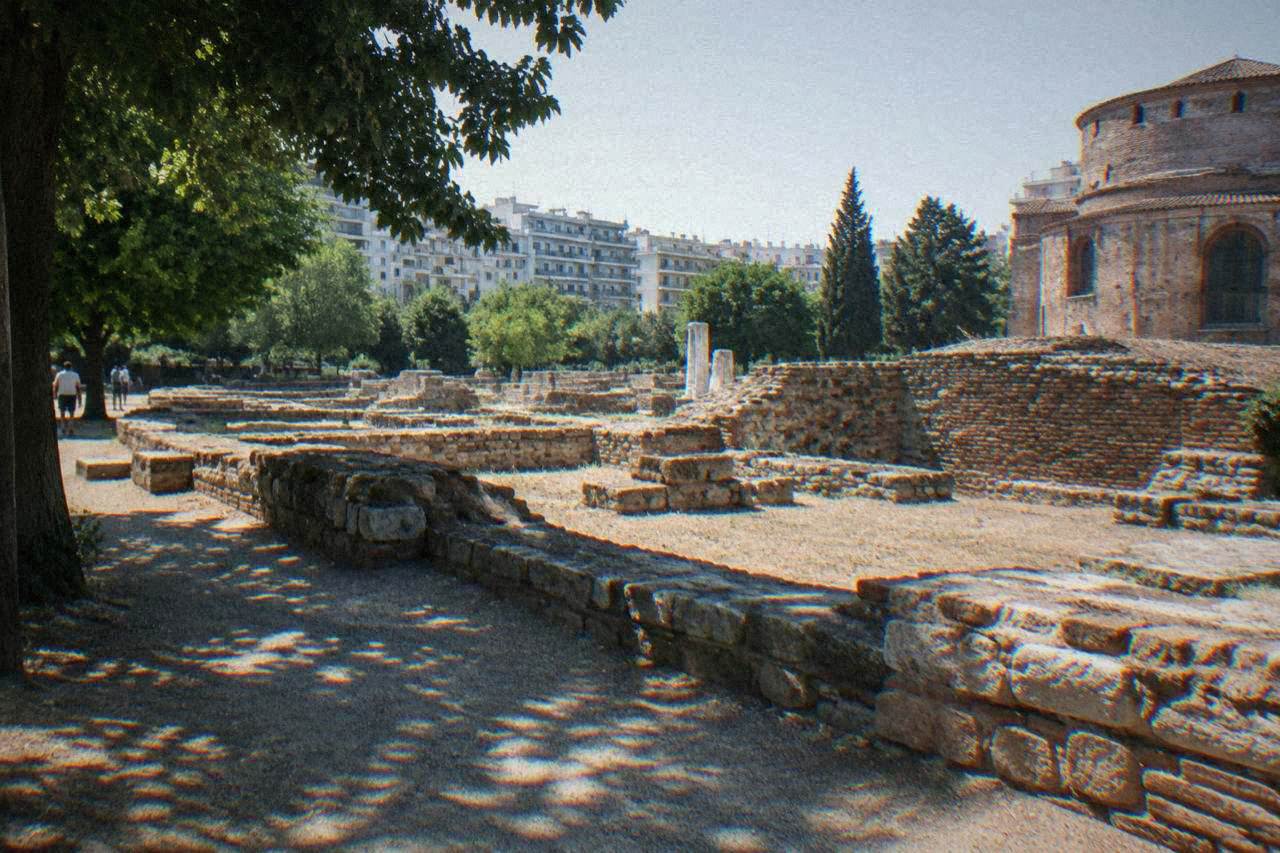
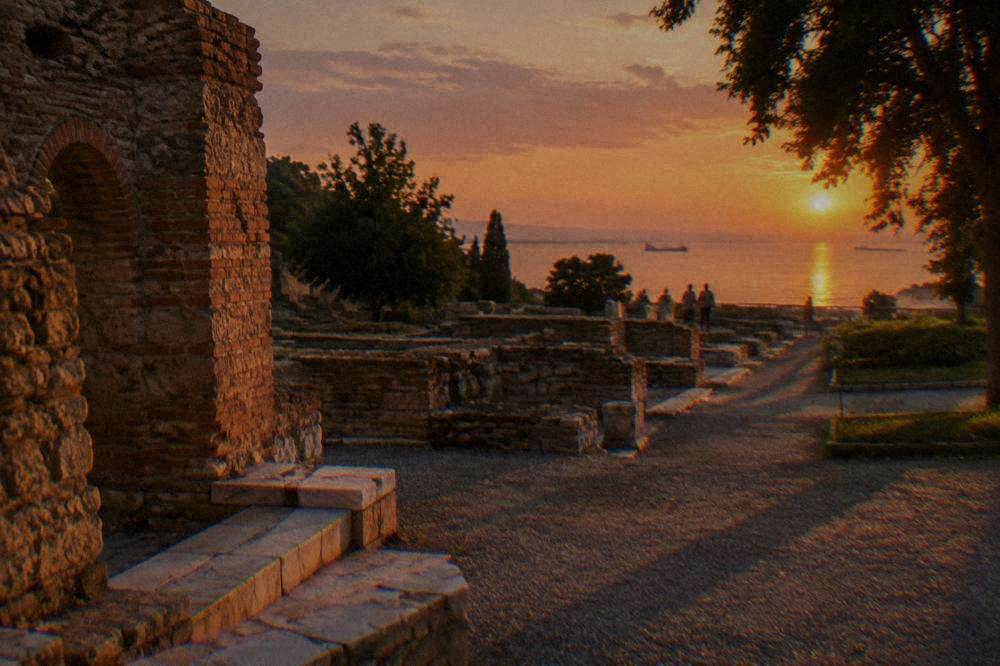
What you meet at ground level is a mix. Some chambers are fenced archaeological enclosures visible from the pavement, some are conserved shells you can walk beside, and the sunken section of the paved palatial street is one of the most photographed stretches of Roman pavement in northern Greece. The ruins are free to view from the street, and they sit in a lively district of apartment blocks, cafes and student life, because the Aristotle University campus begins a few blocks east. Ancient and modern share the same block without a fence between them, which is the palace's real character.
Where Is The Galerius Palace In Thessaloniki And How Do You Get There?
The Galerius Palace ruins lie in central Thessaloniki, spread around Navarinou Square and along Dimitriou Gounari street, roughly halfway between Aristotelous Square and the city walls of Ano Poli, and about 10 minutes on foot from the White Tower along the seafront side of the grid.
The nearest metro stations are on Line 1, open since November 2024 with the Kalamaria extension since 27 August 2026, and the basic metro ticket costs 0.60 euro with a 24-hour ticket at 2.50 euro, per the Thessaloniki Metro's own ticket page.
The palace district is compact and walkable. From Aristotelous Square, the central square laid out after the Great Fire of 1917 left 73,000 people homeless and the Hebrard plan rebuilt the centre, walk two blocks east along the grid to reach Egnatia street, and the ruins begin a few blocks further along. The Arch of Galerius stands where Egnatia crosses Dimitriou Gounari, and from there the whole palace axis unrolls uphill to the Rotunda. Signage in the area is thin, so the arch is the practical landmark to aim for: it is an open-air street monument, free to view, and everything else in the complex stands within a short walk of it.
The metro makes the approach simple from further out. Line 1 runs from the New Railway Station to Nea Elvetia, with the Kalamaria branch adding five stations out to Mikra, and trains run 05:15 to 00:30 Sunday to Thursday and 05:15 to 02:00 Friday and Saturday, per the operator's site. From the airport, the OASTH X2 and X3 airport buses connect to the Nea Elvetia and Mikra metro stations, and the reported airport bus fare is about 2 euro. A day taxi from the airport to the centre is reported at about 25 euro, though that figure comes from secondary sources, so confirm before relying on it.
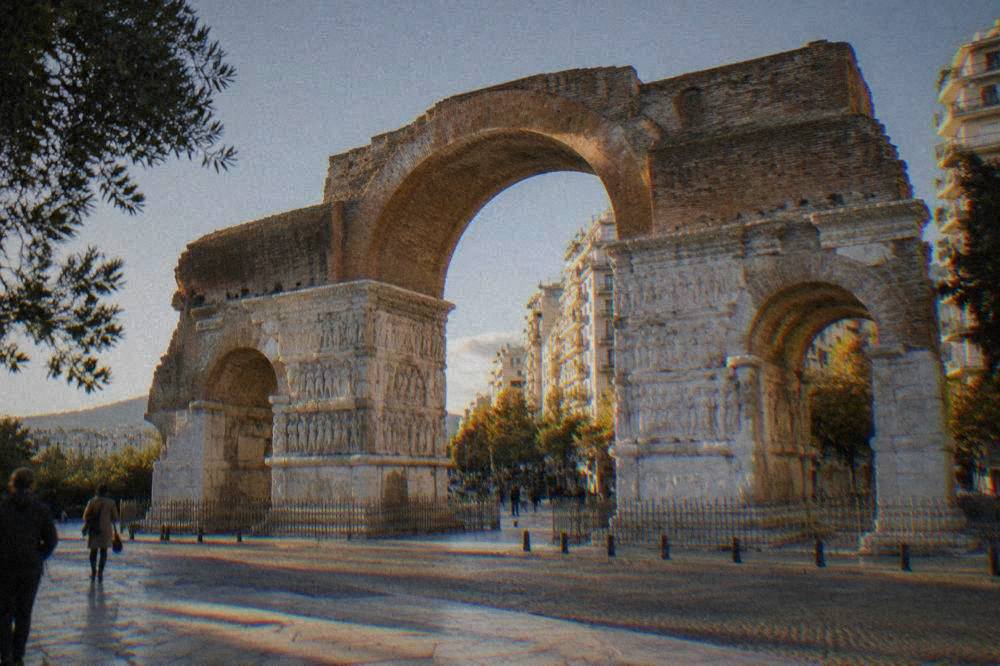
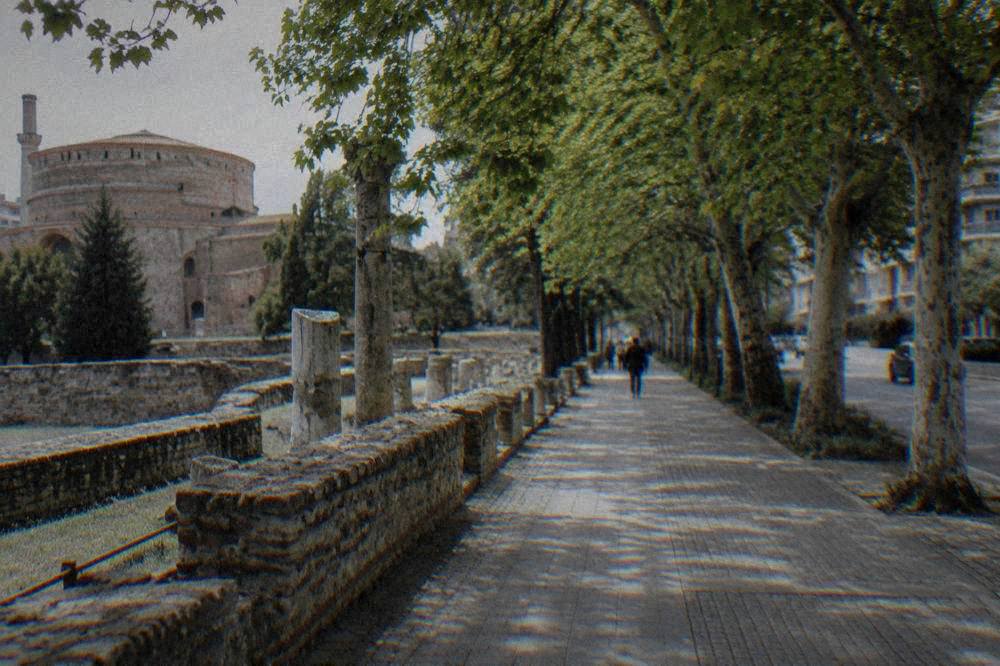
For orientation, the whole Galerian complex runs as a straight sequence: the Rotunda at the top of the axis, then the arch, then the palatial street and the palace core around Navarinou Square, with the Roman Agora of Thessaloniki a few blocks west near the upper end of Aristotelous Square. Walk the sequence in either direction in well under an hour of pure walking, with the Rotunda and the Arch of Galerius each covered by their own pages on this site.
| Route to the palace area | How it works | Figure given by the operator or reported |
|---|---|---|
| On foot from Aristotelous Square | Straight through the street grid to the arch | Central, no figure needed |
| Metro Line 1 | New Railway Station to Nea Elvetia, plus Kalamaria branch | 0.60 euro basic, 2.50 euro daily (V) |
| Metro hours | Sunday to Thursday, Friday and Saturday | 05:15 to 00:30, 05:15 to 02:00 (V) |
| Airport bus X2 or X3 | Connects airport to Nea Elvetia or Mikra stations | Reported about 2 euro, confirm locally |
| Taxi from the airport | Day rate to the centre | Reported about 25 euro, confirm locally |
What Are The Opening Hours And Ticket Prices For The Galerius Palace In Thessaloniki?
The open-air parts of the Palace of Galerius, including the fenced palatial street and the Arch of Galerius, are free and visible from public streets at any hour. Enclosed halls follow the state pattern of long summer days, reported to about 20:00, with the Apsidal Hall open only for a two-hour midday window. No ticket price is confirmed, so check official pages before a timed visit.
This is the one section of the guide where precision matters, because the palace is not a single ticketed gate. The complex belongs to the Greek state archaeological service, and hours for the enclosed parts follow the general state pattern of long summer days and shorter winter ones, with reported summer opening to about 20:00. Winter arrangements, including possible Tuesday closures at some state sites in the low season, are reported but vary, so the practical advice is to treat any specific hour as unconfirmed until checked. The Apsidal Hall, one of the conserved palace chambers, is reported to open only for a two-hour midday window, which is the kind of detail that ruins a tightly planned morning if assumed otherwise.
On prices, silence is safer than a number. Figures circulating for the Galerian complex and for a combined state-sites ticket of about 15 euro full and 8 reduced are reported rather than confirmed on the official pages, and a reported combined ticket is a poor basis for a budget. What is confirmed is the price structure at the major museums nearby: the Archaeological Museum of Thessaloniki lists 10 euro full and 5 euro reduced, the Museum of Byzantine Culture lists 10 euro full and 5 reduced, and the White Tower 8 euro full and 4 reduced from 1 April 2026, all per their own visiting pages. State museums also open free on fixed days: 6 March, 18 April, 18 May, the last weekend of September and 28 October, plus the first and third Sundays of November to March at participating sites.
For a full rundown of the museum circuit, the Archaeological Museum and the Museum of Byzantine Culture pages carry the confirmed figures, and the White Tower page has the current tower ticket. None of those prices apply to the palace ruins themselves.
| Sight | Confirmed ticket | Notes |
|---|---|---|
| Palace of Galerius, open-air ruins | Free to view from the street | Enclosed halls reported only |
| Arch of Galerius | Free, open-air street monument | Visible at any hour |
| Rotunda | No confirmed price | Reported figures only, check locally |
| Archaeological Museum | 10 euro full, 5 euro reduced | Per its own visiting page |
| Museum of Byzantine Culture | 10 euro full, 5 euro reduced | Per its own visiting page |
| White Tower | 8 euro full, 4 reduced from 1 April 2026 | Per the museum's visiting page |
| Free-admission days (state museums) | 6 Mar, 18 Apr, 18 May, last Sep weekend, 28 Oct | Confirmed by the museums' pages |
What Can You See Inside The Galerius Palace Complex In Thessaloniki?
The visible palace in Thessaloniki today consists of the sunken paved stretch of the palatial street, the remains of the arch's marble pylons with their carved relief panels, substructures and chamber walls around Navarinou Square, and the great brick mass of the Rotunda standing at the top of the axis, and the carved scenes on the arch, celebrating Galerius's Persian campaign, form the most complete sculptural programme visible anywhere in the complex.
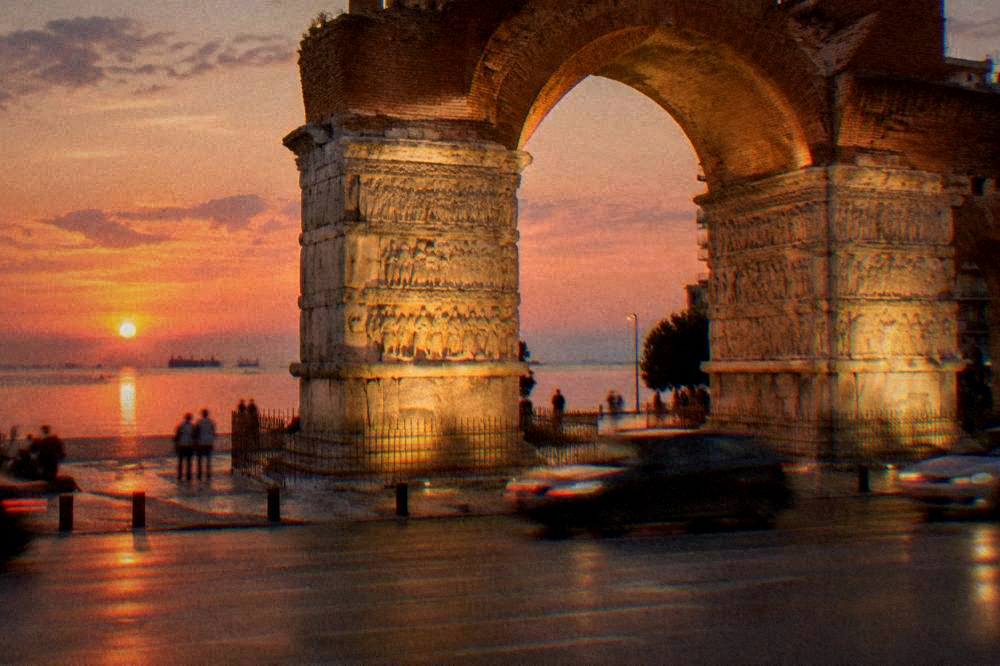
Start at the arch, because its reliefs tell the story the stones cannot. The marble panels that survive on and around the piers show the tetrarch's campaign in the east in sequence: marching, battle, the submission of captives and the emperor's family in ceremonial pose. Some panels remain in place on the structure, and others stand beside it at eye level, which makes this one of the more legible Roman monuments in Greece. The arch stood astride the processional route, and its two main piers still frame the modern crossing of Egnatia and Dimitriou Gounari.
From the arch, walk uphill along Dimitriou Gounari to reach the exposed section of the palatial street, sunk below the modern pavement on the north side. The ancient road surface, kerbs and drainage survive in a fenced enclosure, and the colonnade bases that line it mark where the covered portico ran. A few steps north, Navarinou Square opens over the palace core, where low chamber walls and vaulted substructures are scattered around the square and the lanes off it, some of them glassed over or left as open ruins beside cafes and apartment entrances. The mosaic floors that came out of the palace, including large figured panels from the colonnades, are held in the state collections; the Archaeological Museum of Thessaloniki is the place to see material from the Roman city.
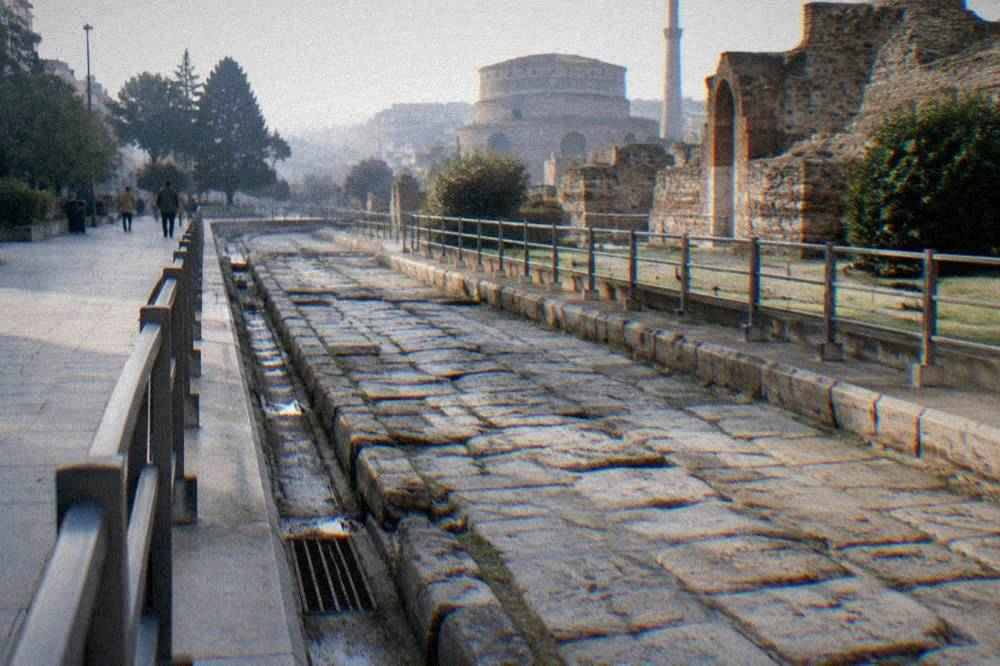
The Rotunda closes the sequence. It is an enormous cylindrical brick building, its purpose in Galerius's own programme debated by scholars and not settled on any official page, later ringed and topped in its Christian phases. Its own page on this site, Rotunda, carries what can responsibly be said. Between the palace and the Rotunda, the line of the ancient hippodrome survives as the straight run of Dimitriou Gounari itself, and noticing it costs nothing.
| Element of the Galerian complex | What survives | How to see it |
|---|---|---|
| Arch of Galerius | Two piers and carved marble relief panels | Free, in the street, any time |
| Palatial street | Paved road, kerbs, drainage, colonnade bases | Fenced enclosure beside Gounari street |
| Palace core and substructures | Chamber walls, vaulted undercrofts | Scattered around Navarinou Square |
| Apsidal Hall | Conserved hall, reported 12:00 to 14:00 opening | Reported, confirm before going |
| Hippodrome | No seating survives; the line runs under Gounari | Read the street shape, nothing fenced |
| Rotunda | Massive brick cylinder at the head of the axis | Separate monument, own page |
What Is The History Of The Galerius Palace In Thessaloniki?
The palace was built for Galerius, the tetrarch who made Thessaloniki an imperial base, and the complex of palace, hippodrome, arch and Rotunda was laid out as a single processional scheme running from the walls down toward the sea, an arrangement the municipality's own history pages record as the tetrarch's great building programme in the city. The palace decayed after the imperial court left, its stone was reused, and the modern city rediscovered the ruins layer by layer from the late 19th century onward.
What the record supports is the programme: a capital-scale complex in a city that had been a regional centre since the Via Egnatia was driven through between 146 and 120 BC.
The Roman empire's Christianisation transformed the neighbourhood's meaning rather than its stones: the Rotunda was adapted, and the city's great churches, including the Church of Saint Demetrius and Hagia Sophia, rose in the centuries that followed, eventually forming part of the UNESCO Paleochristian and Byzantine Monuments of Thessaloniki inscribed in 1988 with fifteen components. The palace itself is Roman, not Byzantine, and it sits outside the UNESCO inscription, a distinction worth knowing when planning a monuments walk.
The Ottoman conquest of 1430 and the centuries that followed buried much of the complex under housing. The Great Fire of 1917 cleared the city centre and led to the Hebrard plan that shaped modern Thessaloniki, and later excavation and rebuilding, along with repair after the 1978 earthquake, progressively exposed the stretches visible today. The 2006 start of metro construction across the city added another wave of finds, and a new museum of the metro excavations has been reported opening at Pavlos Melas with hours of 08:30 to 15:30 except Tuesdays, per press reports, a reminder that the Roman and Byzantine city is still surfacing.
How Long Does A Visit To The Galerius Palace In Thessaloniki Take?
A walk of the open-air palace axis in Thessaloniki, from the Arch of Galerius up the palatial street to the Rotunda, takes under an hour at a steady pace, and a half day is enough to add the Rotunda, the Roman Agora and one museum to the same circuit, while a full day covers the whole central complex of ruins, churches and museums without rushing. The unenclosed parts impose no schedule at all, since the arch and the street enclosure are visible from public pavement at any hour.
Timing depends on depth. At the fastest, the sequence of arch, street and Navarinou Square is a 30-minute thread, and many visitors walk it en route between the White Tower and the Ano Poli without ever treating it as a destination. Add time inside the Rotunda if it is open, and add the time to reach it: reported hours for enclosed state sites, including the palace halls, are unconfirmed past the summer pattern of opening to about 20:00, so a morning visit is the safer plan for anything behind a gate.
The guided options change the arithmetic. A themed walk that puts the palace in its Roman and early Christian context fits an afternoon slot, and this site's featured pick, the Apostle Paul's Story Walking Tour, uses the Roman city as its stage, tying the Galerian axis to the later Christian Thessaloniki in one continuous narrative. Check availability on the operator's live listing.
Weather shapes the visit more than the clock. The HNMS Thessaloniki Mikra station record, 1959 to 2010, gives a July mean high of 31.7 C against a January mean low of 1.5 C, and the shaded excavation enclosures offer little protection in either direction. December carries the highest monthly rainfall in that station record at 55.1 mm and August the lowest at 19.3 mm, so summer evenings are the comfortable window for the open-air stretches, and midday summer walks are best swapped for the air-conditioned museums nearby.
What Else Is Near The Galerius Palace In Thessaloniki?
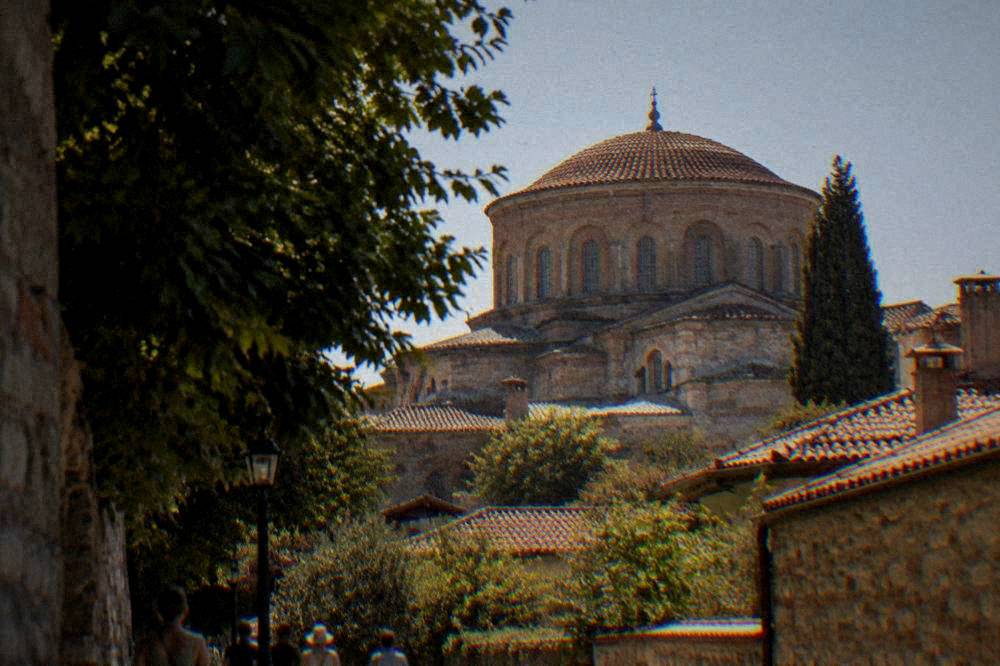
The palace sits in the densest sightseeing block in Thessaloniki: the Rotunda stands at the head of its axis, the Roman Agora lies a few blocks west, the Church of Saint Demetrius and Hagia Sophia are within the same central strip, Aristotelous Square and the White Tower are short walks downhill, and the upper town of Ano Poli with the Heptapyrgion rises behind, all reachable on foot without transport.
Work outward from the arch. Two blocks west along Egnatia stands the site of the Roman Agora, the city's Roman-era civic centre, with its own enclosure and museum. Further along, the Church of Saint Demetrius honours the city's patron saint, whose name day on 26 October doubles with the anniversary of the city's liberation on 26 October 1912. Working churches of this kind are free to enter and open outside services, with no confirmed published hours, so a service-time visit is the reliable plan. Hagia Sophia, another of the UNESCO fifteen, stands a short walk north of Egnatia.
Downhill toward the sea, Aristotelous Square opens onto the Nea Paralia, the seafront promenade that runs to the White Tower. The promenade is exactly that, a walking waterfront rather than a swimming beach; swimming means a trip out to Perea, about 28 minutes by road, or further afield. Uphill in the other direction, the lanes of Ano Poli climb through the Byzantine walls to the Heptapyrgion, the fortress that served as a prison until 1989, and the Trigoniou Tower viewpoint.
For food stops, the market halls anchor the local table. Modiano Market and Kapani Market both sit in the central grid west of the palace, and the city's gastronomic reputation, the reason its municipal gastronomy site exists within the UNESCO Creative Cities network, makes a market walk a natural companion to a ruins walk. A fuller list of the city's sights is on the site's root guide to things to do in Thessaloniki.
| Nearby sight | Direction from the palace | Practical note |
|---|---|---|
| Rotunda | Top of the palace axis, uphill | No confirmed price, check locally |
| Roman Agora | West along Egnatia | Own enclosure and museum |
| Church of Saint Demetrius | West, toward the centre | Free, open outside services |
| Hagia Sophia | North of Egnatia | UNESCO monument, free entry |
| Aristotelous Square | Downhill to the sea | Open square, always accessible |
| White Tower | Seafront east of Aristotelous | 8 euro full from 1 April 2026 |
| Ano Poli and Heptapyrgion | Uphill through the walls | Steep lanes, no confirmed price |
Can You Visit The Galerius Palace On A Guided Tour Of Thessaloniki?
Yes, the palace axis is a standard stop on Thessaloniki's city walking tours, and thematic walks covering the Roman city, the early Christian churches or the Apostle Paul's time in Thessaloniki all pass the Arch of Galerius and the palatial street, so choosing a tour is a matter of theme and depth rather than access, since the open-air ruins themselves need no ticket, no guide and no booking.
This site's featured tour for the palace is the Apostle Paul's Story Walking Tour, a themed walk built around the Roman city the apostle knew. The attraction for a palace visit is contextual: a guide unpacks the tetrarchy, the processional route and the way the Roman axis shaped the Christian city that followed, which is the story the ruins struggle to tell alone.
Two other formats suit the palace well. A bike tour that sweeps the White Tower, the Rotunda and the palace axis covers the whole Galerian sequence plus the seafront in one loop, which suits visitors compressing the city into a single day. A hop-on hop-off sightseeing bus works for the wider circuit once the central walk is done, linking the palace district to points further out along the promenade.
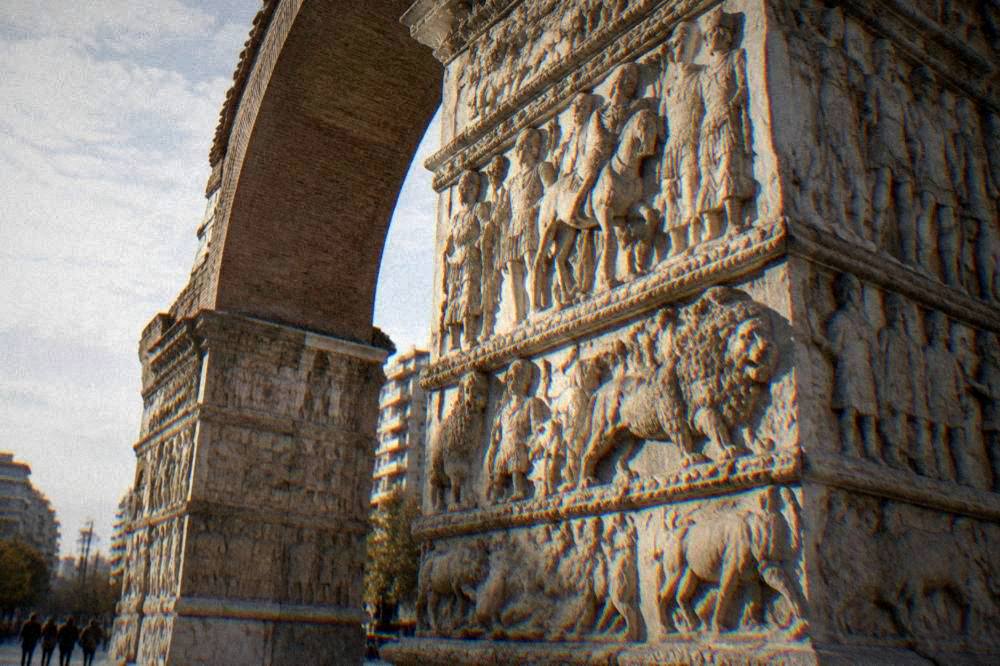
For visitors who prefer to go alone, the palace is forgiving. The arch's reliefs reward a slow circuit, the street enclosure is self-explanatory, and the Archaeological Museum's galleries carry the Roman city's story indoors. Combine a solo palace walk with the museum and you have the substance of a guided tour at the cost of one confirmed 10 euro museum ticket.
Is The Galerius Palace In Thessaloniki Suitable For Families And Short Visits?
The Galerius Palace in Thessaloniki works well for families and short visits because the core circuit is short, free, unfenced and finishes beside cafes and an open square, the carved arch panels give children something concrete to look at, and a stop can last 20 minutes or a whole morning depending on appetite, with the metro and the seafront both within easy walking distance for the next activity.
The open-air format removes the usual museum friction. There is no queue, no ticket line and no quiet-gallery pressure, and Navarinou Square is a student hub with the practical services that implies. The sunken street enclosure has railings and clear sightlines, so supervision is simple. The paved stretches are city pavement, so strollers are no obstacle on the main circuit, though the side lanes toward Ano Poli climb steeply and are better saved for older legs.
For a short visit, a layover or a cruise-port day, the palace axis is one of the highest-yield stops in the city: maximum archaeology per minute, central, and combinable with the White Tower and a seafront walk inside a few hours. The site's pages on a Thessaloniki cruise port day and one-day itineraries cover the compressed routes. In rain, the exposed stretches lose their appeal quickly, and the swap is easy: the Archaeological Museum and the Museum of Byzantine Culture both sit within the same central strip, with confirmed hours and tickets on their own pages.
On a hot day, invert the plan. The palace stones hold heat, the HNMS Thessaloniki Mikra station record showing a July mean high of 31.7 C, so the open-air circuit is best early or late, with the museums and the Modiano Market hall in the middle of the day.
Common Questions About The Galerius Palace In Thessaloniki
Is the Palace of Galerius in Thessaloniki free to visit?
The open-air ruins, including the Arch of Galerius and the fenced view of the palatial street, are free to view from public pavement at any time. Enclosed exhibition halls of the Galerian complex have reported hours but no confirmed ticket price, so check the official ticketing pages before a timed visit.
How do I get to the Galerius Palace in Thessaloniki?
The ruins lie around Navarinou Square, with the arch at the crossing of Egnatia and Dimitriou Gounari. Line 1 of the Thessaloniki Metro, open since November 2024 with the Kalamaria extension since 27 August 2026, serves the centre, and the basic metro ticket is 0.60 euro with a 24-hour ticket at 2.50 euro, per the operator's ticket page.
What are the opening hours of the Galerius Palace in Thessaloniki?
Open-air parts are visible at any hour. Enclosed halls of the complex are reported to open in summer until about 20:00, with the Apsidal Hall reported at 12:00 to 14:00 only. These hours are reported rather than confirmed, so confirm before you go.
Is the Galerius Palace the same as the Arch of Galerius?
No. The arch is the triumphal monument at the midpoint of the complex, free to view in the street. The palace is the residential and ceremonial ruin spread around Navarinou Square, and the Rotunda stands at the head of the same processional axis. All three belong to Galerius's building programme in the city.
Is the Galerius Palace part of the UNESCO sites in Thessaloniki?
No. The UNESCO inscription of 1988, "Paleochristian and Byzantine Monuments of Thessaloniki", covers fifteen Early Christian and Byzantine monuments. The Roman palace predates that phase and sits outside the inscription, though many UNESCO churches, including Hagia Sophia and the Church of Saint Demetrius, stand within walking distance.
How much time do I need for the Galerius Palace in Thessaloniki?
The open-air axis takes under an hour at a steady pace. Add the Rotunda, the Roman Agora and one museum for a comfortable half day, or pair the ruins with the central churches and markets for a full day in the same walkable district.
The palace rewards exactly the kind of slow, source-checked looking this site is built for. Stand at the arch, walk the line the emperor rode, and the modern street grid quietly hands you the shape of a Roman capital, no ticket required for the part that matters most.