Hagia Sophia Of Thessaloniki: The Dome Mosaic
Hagia Sophia is one of Thessaloniki's fifteen UNESCO-listed Paleochristian and Byzantine monuments, a working church on the corner of the modern centre whose dome mosaic of the Ascension is the single reason many travellers walk through its doors.
Short answer
Hagia Sophia in Thessaloniki is a working Byzantine church on Agias Sofias street, free to enter and open outside services, with a famous Ascension mosaic inside the dome; it is one of the city's fifteen UNESCO-listed monuments.
Hagia Sophia in Thessaloniki, the second city of Greece on the Thermaic Gulf in Central Macedonia, is a working Byzantine church that holds one of the finest dome mosaics surviving anywhere in the Byzantine world: the Ascension, a composition of Christ lifted in a mandorla between the Virgin, the apostles and four angels. The church is one of the fifteen Paleochristian and Byzantine Monuments of Thessaloniki inscribed on the UNESCO World Heritage List in 1988, and it stands today on the corner of Agias Sofias and Ermou streets, a few minutes on foot from Aristotelous Square. Entry is free. This guide from the Thessaloniki Travel Guide covers what the mosaic shows, how the building changed across the Byzantine centuries, what else to see inside, and how to fit the church into a wider walk through the city.
What Is The Hagia Sophia Of Thessaloniki?
Hagia Sophia is a Byzantine church in central Thessaloniki, dedicated to Holy Wisdom, and one of the fifteen monuments that make up the city's UNESCO World Heritage inscription of 1988. It is a working Orthodox church, free to enter and open outside service times, and its dome carries a mosaic of the Ascension that survives in remarkable condition after an earthquake, fire, conversion to a mosque and reconversion to a church.
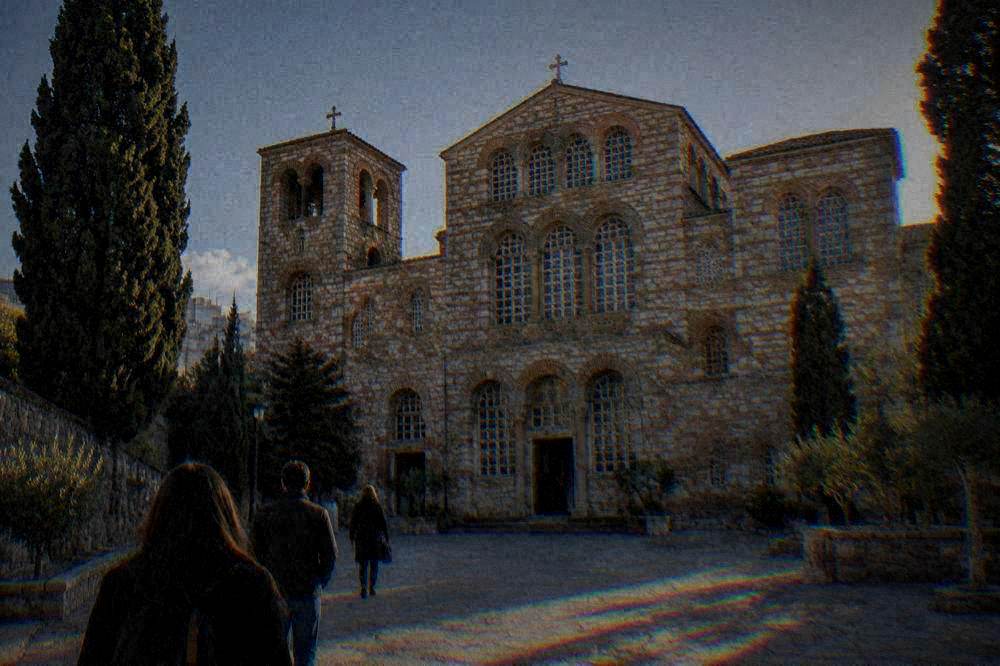
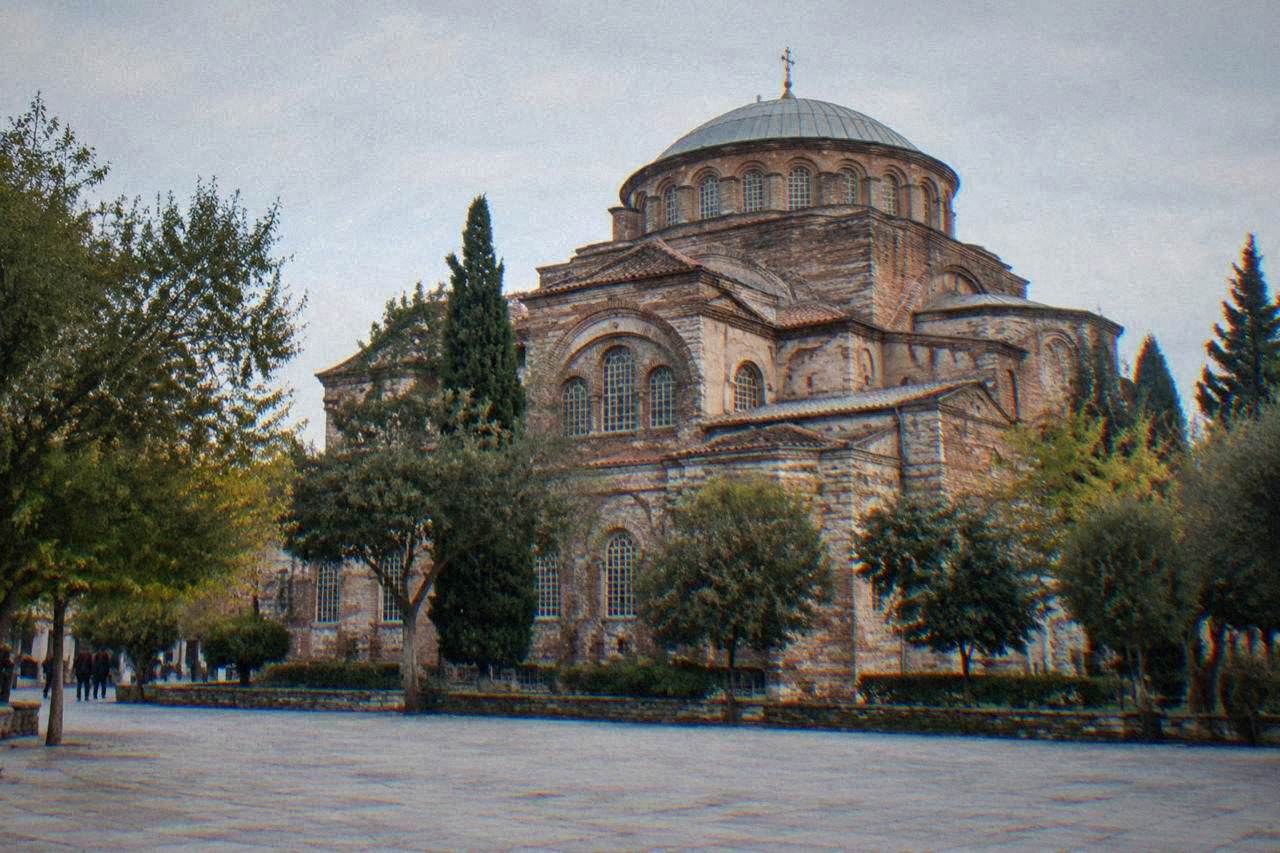
The name "Hagia Sophia" means Holy Wisdom, and it links the church to a family of great Byzantine churches, most famously the Hagia Sophia of Constantinople, modern Istanbul. The Thessaloniki church is much smaller than its namesake but belongs to the same architectural tradition: a domed cross-in-square plan, thick brick and stone walls, and a domed crossing lit from high windows. The municipality's own monument pages place it among the city's core Byzantine sights, alongside the Rotunda, the Church of Saint Demetrius and the churches of Ano Poli such as Hosios David.
Its position matters as much as its architecture. The church sits between the plateia of Agias Sofias and the busy shopping streets of the modern centre, so it is not a monument you travel out to: it is one you pass through on almost any walk between the seafront and the Roman Forum. The Archaeological Museum and the Museum of Byzantine Culture both hold material that helps you read what you see inside the church, and both are a short bus or metro ride away.
What Does The Dome Mosaic Of The Ascension Show?
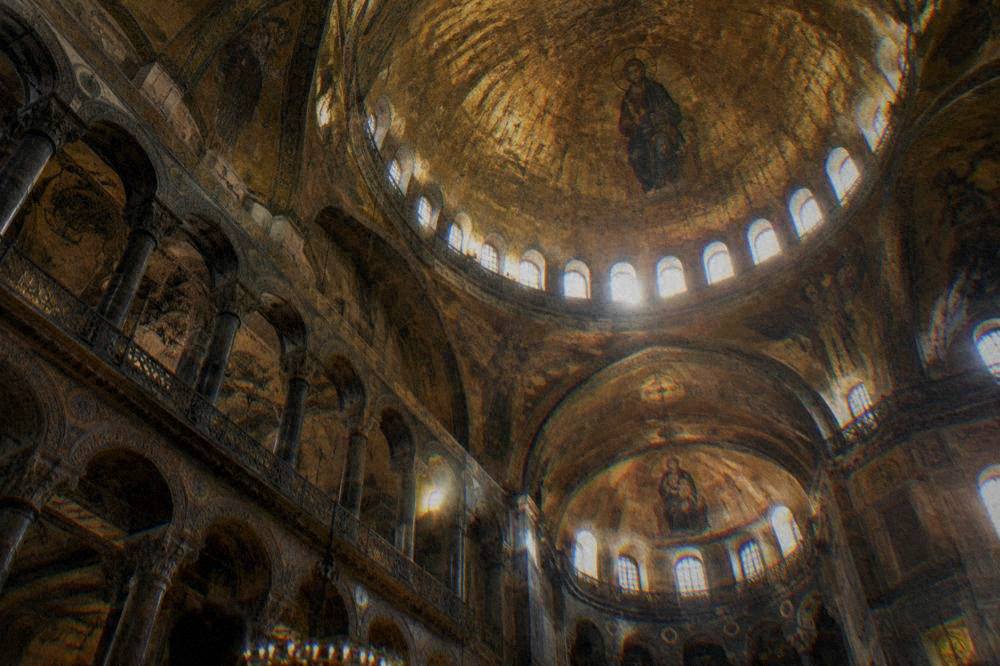
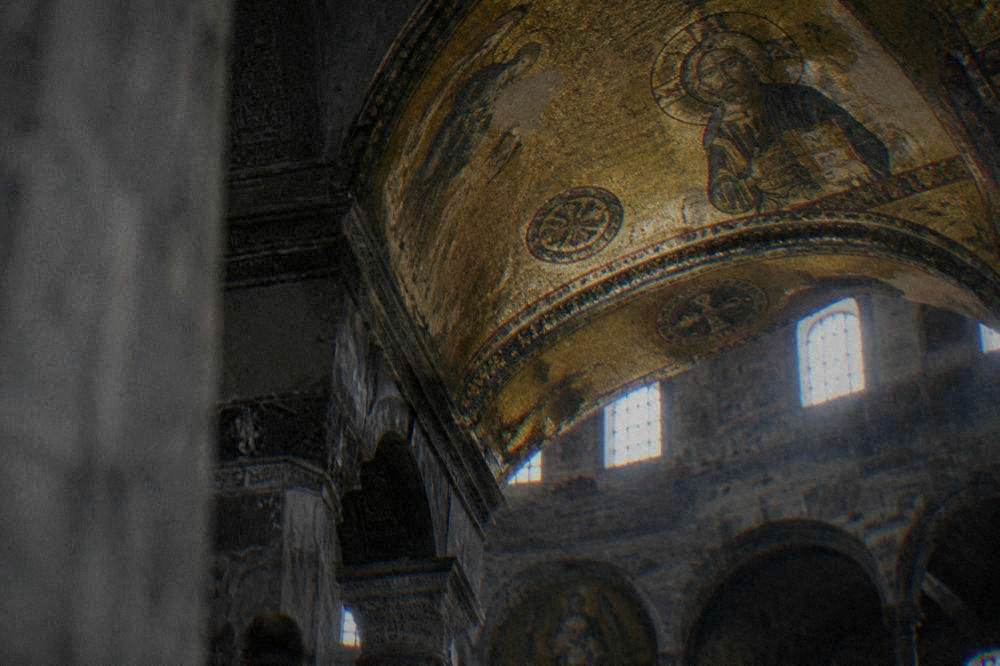
Inside the dome, a mosaic of the Ascension shows Christ in a blue mandorla held by two angels, rising while the Virgin Mary stands in prayer below, flanked by two apostles and, higher in the drum, the remaining apostles between windows, with four angels at the base of the composition. It is the most complete dome mosaic of its kind surviving in Thessaloniki.
The composition follows a scheme established in early Byzantine art. Christ sits or rises within the mandorla, an almond of light, borne upward. The Virgin stands in the centre of the floor of the composition in an orans pose, arms raised. The apostles, arranged in a ring, turn toward Christ. The angels at the rim are shown in motion, their drapery cut against the gold ground. The gold tesserae catch the light from the dome windows, which is why the mosaic changes character through the day.
The mosaic's date is tied to the church's history. After an earthquake damaged the earlier dome, the mosaic was made in the period after the end of Iconoclasm, when figural imagery returned to Byzantine churches. Scholars describe it as a high point of the middle Byzantine revival of figural art. Alongside the dome, the church preserves a mosaic of the Virgin and Child in the apse, set after the dome composition, and fragments of frescoes from the Palaiologan period, the last flowering of Byzantine painting, in the side chapels and narthex.
How Old Is Hagia Sophia In Thessaloniki?
The church in its present form is a middle Byzantine building, its dome mosaic added after an earthquake damaged the earlier dome, its apse mosaic of the Virgin and Child set later still, and its Palaiologan frescoes painted in the final centuries of Byzantine rule. It was converted to a mosque after the Ottoman conquest of 1430 and returned to Orthodox worship in 1912, when the Greek army entered the city on 26 October.
The city itself was founded in 315 BC by Cassander and named for his wife Thessalonike, a daughter of Philip II, and by the early Byzantine centuries it had become the second city of the Byzantine world after Constantinople. Hagia Sophia was built as the city's cathedral in that period, taking over the role from the Rotunda, and an earlier church is believed to have stood on or near the same spot. The exact construction dates of individual churches in Thessaloniki are not settled in the official sources, so a visitor should treat the broad period labels rather than precise years as the reliable frame.
The Ottoman period left its mark. After 1430 the church became a mosque, as happened to nearly all of the city's major Byzantine churches, including the Church of Saint Demetrius and Panagia Acheiropoietos. Figural mosaics were covered rather than destroyed in some cases, and much of what a visitor sees today was cleaned and restored after 1912. The church survived the Great Fire of 1917, which devastated the centre and left 73,000 people homeless, and the earthquake of 1978, which damaged many of the city's Byzantine monuments and prompted a long restoration campaign.
How Much Does Hagia Sophia In Thessaloniki Cost And When Can You Visit?
Entry to Hagia Sophia is free, because it is a working Orthodox church: the churches of Thessaloniki, including Saint Demetrius, Panagia Acheiropoietos, Hosios David and the Vlatadon Monastery, are open to visitors outside service times and charge no admission. No published timetable of opening hours for the church exists in the official sources, so check locally at your hotel or the tourist information centre at Aristotelous Square before setting out.
That answer surprises readers who expect museum pricing, so it is worth being precise about what is and is not ticketed in Thessaloniki. The state museums charge: the White Tower costs 8 euro full and 4 euro reduced from 1 April 2026, and the Archaeological Museum and the Museum of Byzantine Culture cost 10 euro and 5 euro, according to their own visiting pages. The working churches do not. What a visitor gets for free at Hagia Sophia is a functioning place of worship, and the etiquette follows from that: dress modestly, keep your voice low, and avoid the altar area behind the iconostasis.
| Sight in central Thessaloniki | Type | Admission |
|---|---|---|
| Hagia Sophia | Working church, UNESCO monument | Free |
| Church of Saint Demetrius | Working church, UNESCO monument | Free |
| Panagia Acheiropoietos | Working church, UNESCO monument | Free |
| Hosios David (Latomou Monastery) | UNESCO monument | Free to view |
| White Tower | State museum | 8 euro full, 4 euro reduced |
| Archaeological Museum | State museum | 10 euro full, 5 euro reduced |
| Museum of Byzantine Culture | State museum | 10 euro full, 5 euro reduced |
Photography is generally accepted inside working Greek churches without flash, but services take priority and the church may close its doors during them. Sunday morning, when the liturgy is sung, is a time to listen from the narthex rather than to tour. If the doors happen to be shut, the neighbourhood fills the gap: Modiano Market and Kapani Market are a short walk west, and the church of Agios Nikolaos Orfanos in the northeast of the centre holds its own cycle of frescoes.
A guided walk turns the church from a quick stop into a story. The Jewish heritage private experience traces the layered history of the streets around Hagia Sophia, and a general city walk places it among the Roman and Ottoman monuments nearby; see the options below.
What Can You See Inside Hagia Sophia Besides The Dome?
Beyond the Ascension dome, the church holds an apse mosaic of the Virgin and Child on a gold ground, Palaiologan wall frescoes in the chapels, a carved marble iconostasis, a floor of reused ancient marble panels, and the narthex with its restored brick facade, all within a compact cross-in-square interior you can read in fifteen unhurried minutes.
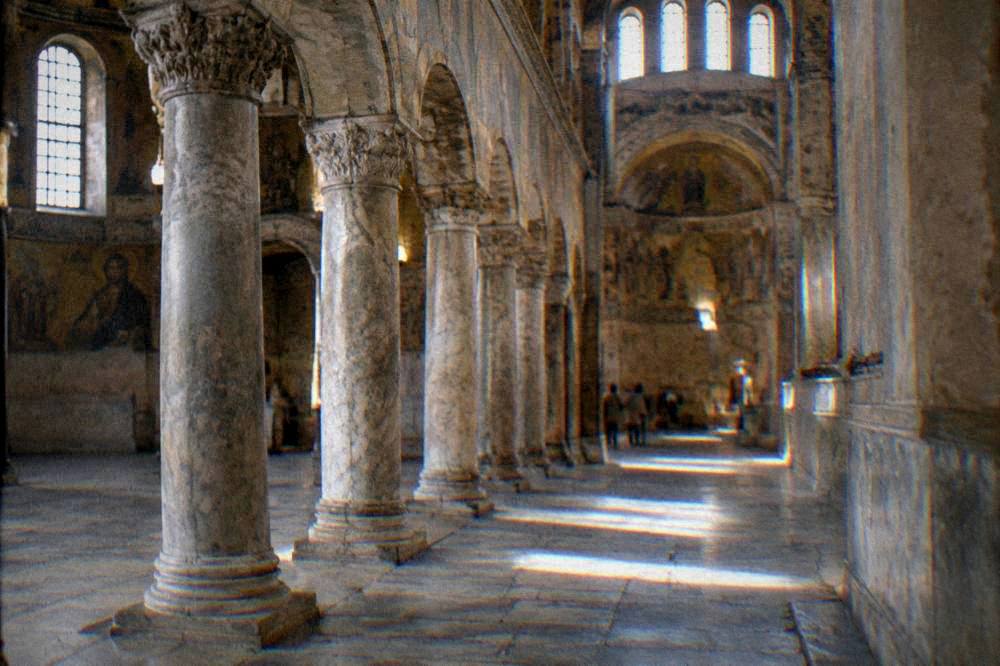
Start at the apse. The Virgin enthroned with the Christ Child, flanked by archangels, looks down over the sanctuary arch, its gold ground in near-continuous original tesserae. Then work outward: the dome above the crossing, the frescoes in the side conches, the chapels off the north and south aisles where fragments of later painting survive, and the iconostasis with its icons of Christ, the Virgin and the patron saints of the church. The floor mixes ancient spolia, reused marble slabs, a habit of Byzantine builders that the city's museums document at length.
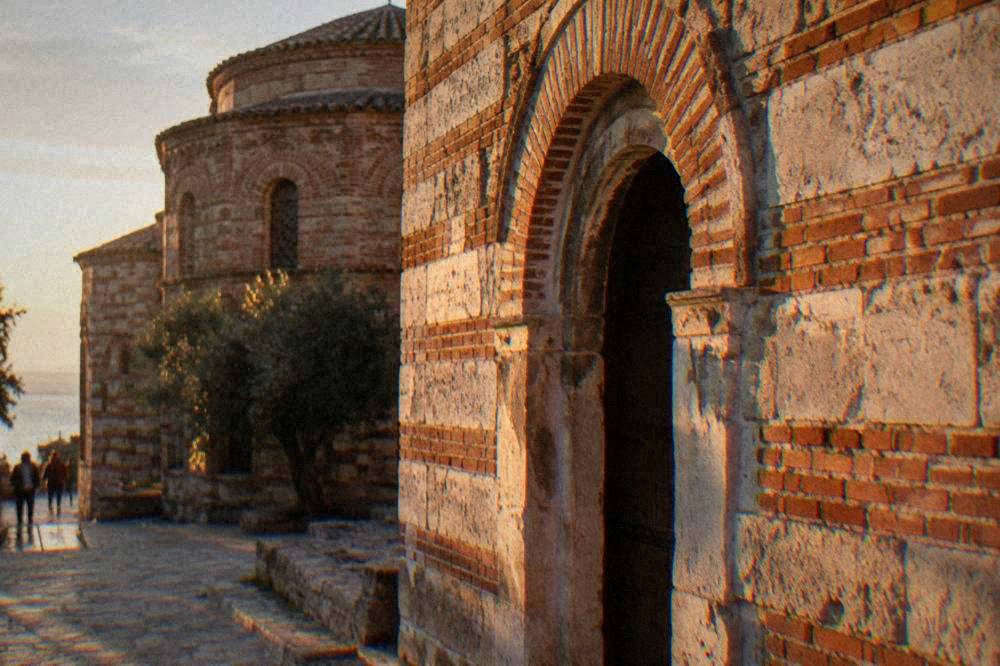
The building itself rewards a slow lap of the exterior. The brickwork is decorated with the arched ceramic inserts typical of middle Byzantine Thessaloniki, visible also at the Church of Saint Demetrius and at Hosios David. From the square on the north side you can see the massing of the domes and the cross-in-square plan in silhouette, which is the clearest way to understand the interior you have just left.
For depth, pair the visit with the Museum of Byzantine Culture, whose galleries display icons, mosaics and sculpture that put the church's decoration in context, from the early Christian centuries to the fall of Byzantium. The museum's visiting page lists daily 08:00 to 20:00 hours in summer and reduced winter hours, with a 10 euro full ticket. The combination of a free church and a ticketed museum is the most efficient way to understand Byzantine Thessaloniki in one afternoon.
How Do You Get To Hagia Sophia In Thessaloniki?
Hagia Sophia stands at the junction of Agias Sofias and Ermou streets, about five minutes on foot from Aristotelous Square and ten from the White Tower on the seafront, in the part of the centre where every walk between the seafront promenade and the markets passes within a block or two of the church; no bus, metro or taxi is needed from anywhere in the city centre.
The metro is open, which matters for travellers staying further out: Line 1 has run from the New Railway Station to Nea Elvetia since November 2024, and the Kalamaria extension was inaugurated on 27 August 2026, adding five stations toward the southeast. The Thessaloniki Metro's ticket page states a basic fare of 0.60 euro and a daily ticket of 2.50 euro, with service from 05:15 to 00:30 Sunday to Thursday and to 02:00 on Friday and Saturday. From the centre, however, the church is a walk, and walking is how the city's Byzantine core is best seen, with the Nea Paralia promenade marking the southern edge of that walkable belt.
| Walking route from Hagia Sophia | Direction | Sights passed |
|---|---|---|
| To Aristotelous Square and the seafront | Southwest | Ermou street shops, the square, Nea Paralia |
| To the White Tower | South | Plateia Navarinou, the Galerian palace remains |
| To the Rotunda and Arch of Galerius | East | Navarinou, the Arch of Galerius on Egnatia |
| To the Roman Forum | West | Shopping streets, the forum excavations |
| To Ano Poli | North | Steep streets to the Byzantine walls and Heptapyrgion |
A circuit works well in one morning: begin at Hagia Sophia, walk east along Navarinou to the Arch of Galerius and the Rotunda, then return west to the Roman Forum and finish at Aristotelous Square. Add the climb to Ano Poli and the Heptapyrgion, the fortress that served as a prison until 1989, only if you have a full day and comfortable shoes, because the ascent is steep and the walls stretch along the top of the old town.
Is Hagia Sophia In Thessaloniki The Same As The Hagia Sophia In Istanbul?
No: the Hagia Sophia of Thessaloniki is a separate and much smaller church, built centuries later than the imperial cathedral of Constantinople, today Istanbul, though the two share the same dedication to Holy Wisdom and the same domed Byzantine tradition; confusing them is common because the Istanbul building dominates the name, and Thessaloniki's church is a parish-sized cross-in-square building rather than an imperial cathedral.
The Istanbul Hagia Sophia was built under Justinian as the largest church in the world. The Thessaloniki church belongs to the middle Byzantine period and to a different scale entirely: a domed parish cathedral of a prosperous provincial capital. The two buildings are related the way a branch is related to a trunk, and the Thessaloniki dome mosaic, with its ring of apostles and its mandorla of Christ, is one of the clearest surviving statements of the tradition the capital set.
The comparison has a practical use. Visitors who know the Istanbul monument arrive in Thessaloniki expecting one colossal building and instead find a compact city of Byzantine churches, fifteen of them on the UNESCO list, clustered within a walkable centre. That density is the city's real distinction: the Bey Hamam, the Ottoman bath nearest to Hagia Sophia, the Vlatadon Monastery up in Ano Poli, and the churches of the upper town together give a continuous thread from the early Christian centuries to the Ottoman conquest of 1430.
What Is The Best Way To Include Hagia Sophia In A Day In Thessaloniki?
The most efficient plan puts Hagia Sophia in the middle of a walking morning: start at the White Tower, walk the Nea Paralia promenade to Aristotelous Square, continue to Hagia Sophia and the Roman Forum, then east to the Arch of Galerius and the Rotunda, with an afternoon in the Museum of Byzantine Culture and a sunset walk or drink in Ano Poli, all doable on foot with a single metro ride at most.
The logic is geographic. The Byzantine and Roman monuments form a belt across the centre: the Galerius Palace remains at Navarinou, the church a few blocks west, the forum beyond it, and the seafront south. A visitor who follows that line east to west, or the reverse, sees the city's three great layers, Roman, Byzantine and Ottoman, without backtracking. The markets at Modiano Market and Kapani Market sit on the western end of that line and make a natural lunch stop.
| Time of day | Plan around Hagia Sophia |
|---|---|
| Early morning | Quiet church visit before the liturgy, then the Roman Forum |
| Late morning | Walk east to the Arch of Galerius and the Rotunda |
| Afternoon | Museum of Byzantine Culture, 08:00 to 20:00 in summer |
| Early evening | Modiano and Kapani markets, then dinner in Ladadika |
| Sunset | Climb to Ano Poli, the walls and the Heptapyrgion viewpoint |
Two cautions make the day smoother. First, church visits and museum visits run on different clocks: the museums publish hours and sell timed entry, while the churches open and close around services, so leave the church for a loose slot rather than a scheduled one. Second, the climb to Ano Poli is a real climb: the upper town sits inside the Byzantine walls high above the centre, and it is best saved for the cool end of the day, particularly in July and August, when the HNMS Thessaloniki Mikra station record, 1959 to 2010, shows mean daily highs of 31.7 C and 31.4 C.
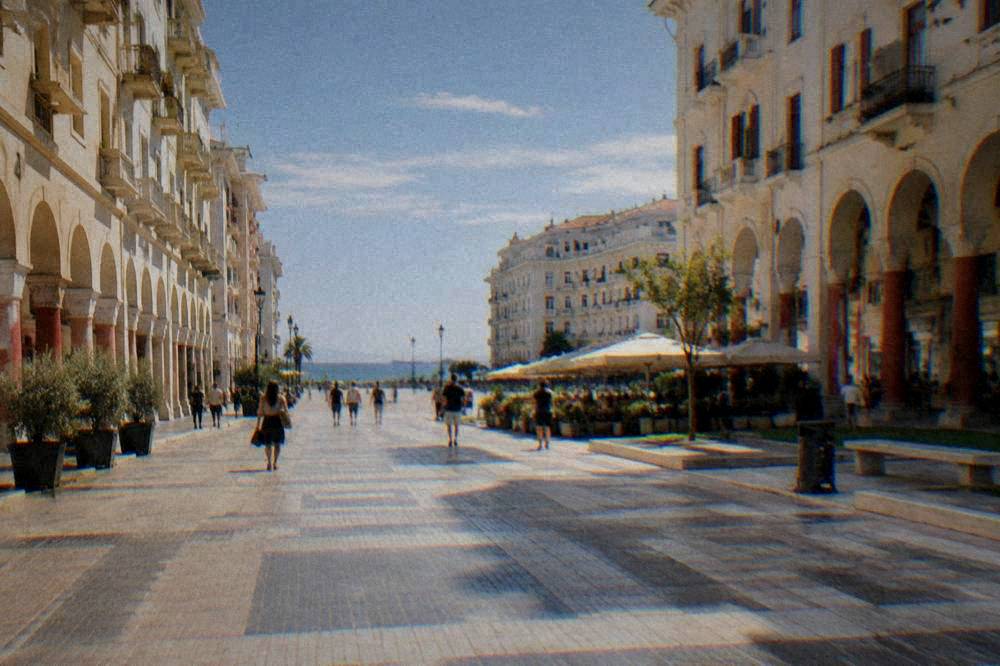
Food gives the day its rhythm. The streets west of the church hold the ouzeri and market traditions the city is known for, and a guided tasting walk is the fastest way into them: the street food tour with a local guide runs through the markets and the Ladadika quarter, and you can check availability on the rotating OTE Tower experience for a view over the whole route from the seafront.
How Does Hagia Sophia Fit The Wider Byzantine Story Of Thessaloniki?
Hagia Sophia is the hinge between the city's Roman and Byzantine layers: it succeeded the Rotunda as the cathedral when Thessaloniki was the second city of the Byzantine world, it carries decoration spanning the middle Byzantine and Palaiologan eras in one interior, and it belongs to a UNESCO inscription of fifteen monuments that together document a thousand years of Christian art, from the early city walls to the late frescoes of the churches of Ano Poli.
Read in that order, the city becomes legible. The Roman layer is the Galerian complex: the Rotunda, the Arch of Galerius and the palace remains, built under the tetrarch Galerius. The early Byzantine layer is the first great churches, Saint Demetrius, Acheiropoietos and Hosios David, with their mosaics. The middle Byzantine layer is Hagia Sophia itself, the dome mosaic above the rebuilt church. The late Byzantine layer is the Palaiologan painting of the final Byzantine centuries, when Thessaloniki was among the last great centres of Byzantine art, seen in the frescoes of Agios Nikolaos Orfanos and the chapels of Hagia Sophia. After 1430 the Ottomans converted the churches to mosques and the story changes register again.
The threads run into the modern city. The Great Fire of 1917 reshaped the centre around the Hebrard plan, producing the Aristotelous Square visitors know today. The liberation of the city on 26 October 1912, the day of Saint Demetrius the city's patron, is marked each year alongside Ochi Day on 28 October. The Jewish Museum and the city's Jewish heritage walks, including the private experience linked above, trace the community whose history ran parallel to the churches for centuries after the Sephardic arrival of 1492.
For a fuller plan, our things to do in Thessaloniki guide lists the sights in order of value, and the Byzantine churches walk pairs Hagia Sophia with its neighbours in a single route.
What Should You Know Before You Visit Hagia Sophia In Thessaloniki?
Before you go, know four things: entry is free and the church is a place of worship, not a museum, so modest dress and quiet are expected; no official opening hours are published, so plan around services and confirm locally; photography without flash is generally tolerated but the altar area is not open to visitors; and the interior is compact, so twenty minutes with the dome mosaic and the apse is a realistic visit, longer if a service is running.
The practical frame around the church is easy. The emergency number across Greece and the EU is 112. Greece uses the euro and is a Schengen member, so intra-Schengen arrivals are border-free. The climate resilience fee, a small per-room per-night charge collected by accommodation and higher from April to October, appears on your hotel bill rather than anywhere near the church. For transport, the metro's 0.60 euro basic ticket and 2.50 euro daily ticket cover the rail lines, and the centre is walkable end to end.
| Question | Answer for this church |
|---|---|
| Admission | Free |
| Opening hours | Not officially published; open around services, confirm locally |
| Dress | Shoulders and knees covered |
| Photography | No flash; altar area closed to visitors |
| Time needed | About 20 minutes, longer during a service |
| Nearest landmarks | Aristotelous Square, Roman Forum, Bey Hamam |
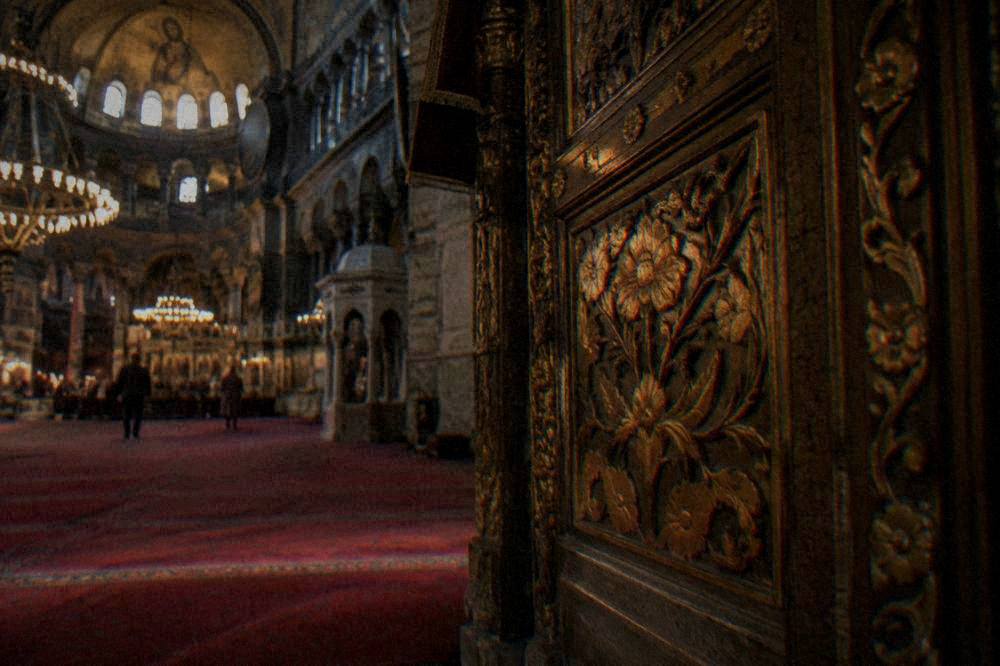
Seasonality is mild. The HNMS Thessaloniki Mikra station table, 1959 to 2010, puts July mean highs at 31.7 C and January mean lows at 1.5 C, with December the highest rainfall month at 55.1 mm, so the church, being indoors and unheated, is as much a winter sight as a summer one. Combine it with the museums on wet days and with the Ano Poli climb on clear ones, and it will hold its place on any Thessaloniki itinerary from February to November.
Common Questions About Hagia Sophia In Thessaloniki
Is Hagia Sophia in Thessaloniki free to visit?
Yes. It is a working Orthodox church and entry is free, as at the Church of Saint Demetrius, Panagia Acheiropoietos and the other working churches of the city. The state museums charge admission, the churches do not.
Is the Hagia Sophia in Thessaloniki the same as the one in Istanbul?
No. The Istanbul Hagia Sophia is the imperial cathedral of Constantinople built under Justinian. The Thessaloniki church is a separate, much smaller middle Byzantine building that shares the dedication to Holy Wisdom and the domed tradition.
What is the dome mosaic of Hagia Sophia in Thessaloniki?
It is a mosaic of the Ascension: Christ in a mandorla borne by angels, the Virgin standing in prayer, and the apostles in a ring between the dome windows. An apse mosaic of the Virgin and Child complements it.
How long does a visit to Hagia Sophia in Thessaloniki take?
About twenty minutes to see the dome, the apse mosaic, the fresco fragments and the iconostasis. Allow longer if a service is running, and check locally for opening times, since the church keeps the hours of a parish rather than a museum.
How do you get to Hagia Sophia in Thessaloniki?
On foot from the centre: it stands at the junction of Agias Sofias and Ermou streets, a few minutes from Aristotelous Square and about ten from the White Tower. The metro, with a 0.60 euro basic ticket per the Thessaloniki Metro's ticket page, serves travellers staying further out.
Is Hagia Sophia part of the UNESCO listing for Thessaloniki?
Yes. It is one of the fifteen Paleochristian and Byzantine Monuments of Thessaloniki inscribed on the UNESCO World Heritage List in 1988, together with the Rotunda, the city walls and the other major Byzantine churches.
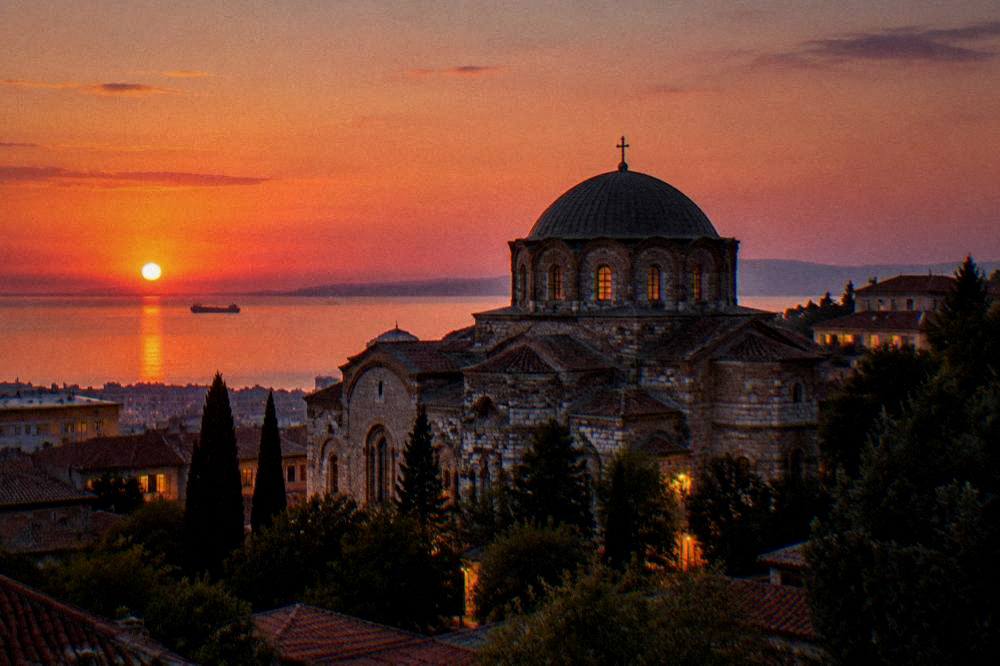
A visit to Hagia Sophia is the shortest route into Byzantine Thessaloniki: one free church, one gold dome, and a walkable city of fourteen more UNESCO monuments around it, all within reach of Aristotelous Square.