Thessaloniki Cafes And Freddo Culture
Coffee in Thessaloniki is not a quick stop, it is the city's default social setting. This guide explains the freddo culture, the neighbourhoods where cafe life happens, and how to order like a local in Greece's second city.
Short answer
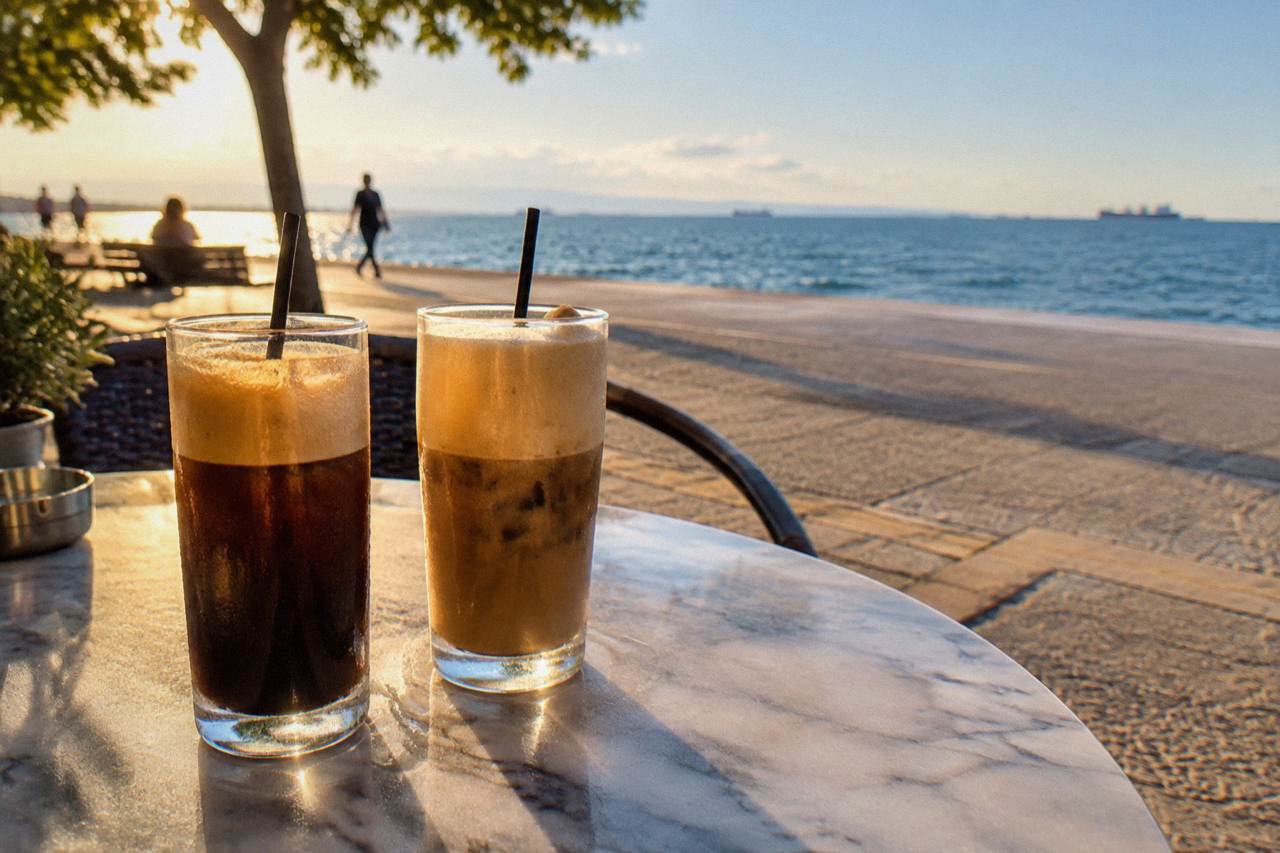
Thessaloniki runs on iced coffee: freddo espresso and freddo cappuccino, served all day in cafes around Aristotelous Square, Ladadika, Ano Poli and Kalamaria. Sitting for an hour over one coffee is normal, and ordering is simple.
Coffee in Thessaloniki, the second city of Greece on the Thermaic Gulf in Central Macedonia, is not fuel, it is the frame the day is built around. Locals meet for coffee in the morning, after work, before dinner and after dinner, and the drink that defines the ritual is served cold: the freddo. This guide covers what freddo culture actually is, which areas of the city carry the cafe life, how ordering and paying work, what to order beyond the two famous iced coffees, and how to fold cafe stops into a wider Thessaloniki day.
What Is Freddo Culture In Thessaloniki?
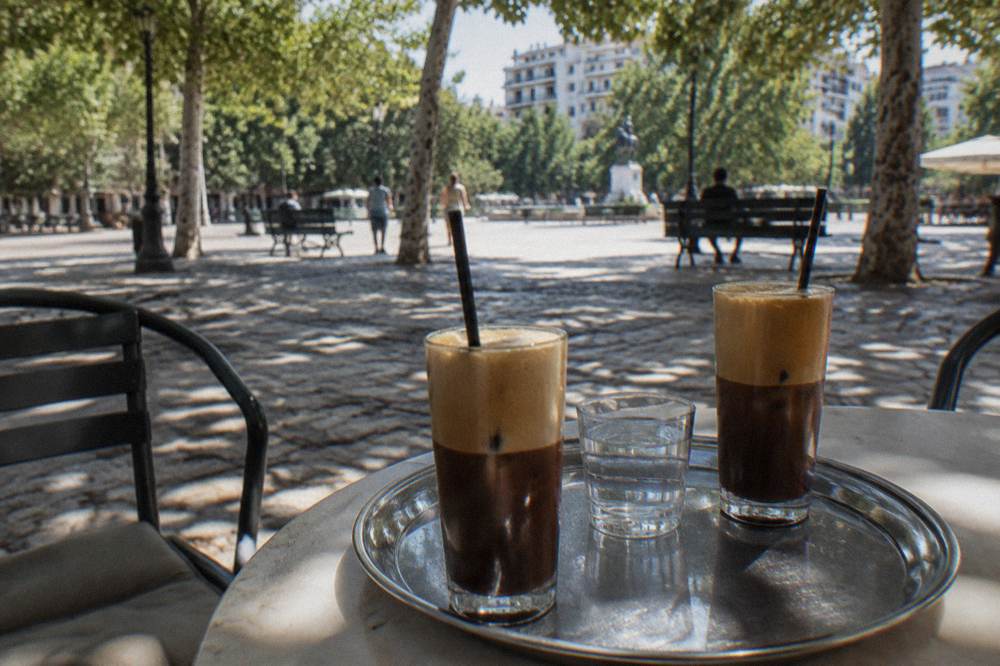
Freddo culture is the Greek habit of drinking coffee cold, all day, sitting down: a freddo espresso is shaken or blended espresso over ice, a freddo cappuccino adds a thick cold milk foam, and in Thessaloniki both are consumed at any hour, in a cafe, at a table, unhurried. The word freddo simply means cold, and the two drinks are the default order in a city where the mean July high is 31.7 C, per the HNMS Thessaloniki Mikra station record, 1959 to 2010. Coffee here is a seated social act, not a takeaway transaction, and a single order can legitimately occupy a table for an hour.
The pattern is recognisably northern Greek. Thessaloniki is a coastal city on the Thermaic Gulf, with the White Tower and the Nea Paralia promenade on the waterfront and the old upper town of Ano Poli behind, and cafe tables spread through nearly all of it. What distinguishes the city's coffee life is its density and duration: cafe terraces around Aristotelous Square face the sea, tables climb the lanes of Ano Poli, and whole boulevards in Kalamaria and the city centre are given over to them.
What this page cannot do is name names. Any page naming "the best cafes in Thessaloniki" with a price list is working from data this site does not hold. Treat every specific cafe recommendation you read elsewhere as unconfirmed until you see the venue itself, and confirm prices when you sit down.
What can be described with confidence is the structure. You sit, a server comes to the table, you order, the coffee arrives in minutes, and you pay at the end either to the server or at the till. Water usually arrives with the coffee without being ordered. Nobody rushes you. That is the whole system, and it is the same in a smart square-front cafe and a two-table spot on an Ano Poli lane.
Which Areas Of Thessaloniki Have The Strongest Cafe Life?
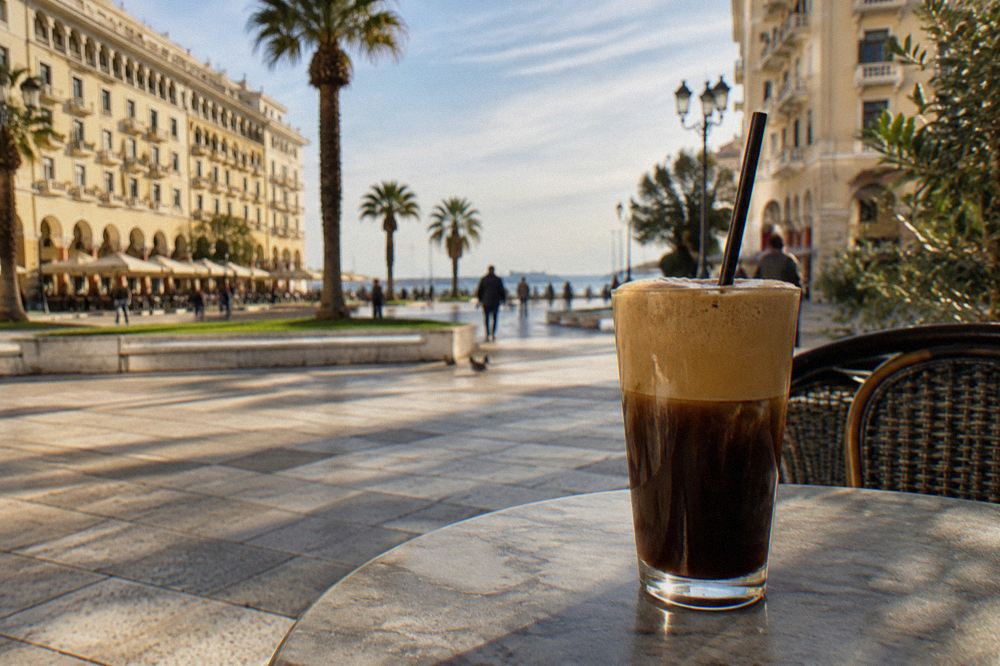
The four core cafe areas of Thessaloniki are Aristotelous Square and the seafront around it, Ladadika, Ano Poli, and Kalamaria, each with a different rhythm: seafront tables for the promenade crowd, Ladadika for evenings, Ano Poli for slow mornings with a view, and Kalamaria for a local, residential feel. Aristotelous Square is the city's central square, designed as part of the reconstruction plan that followed the Great Fire of 1917, and its cafe tables face down toward the Thermaic Gulf.
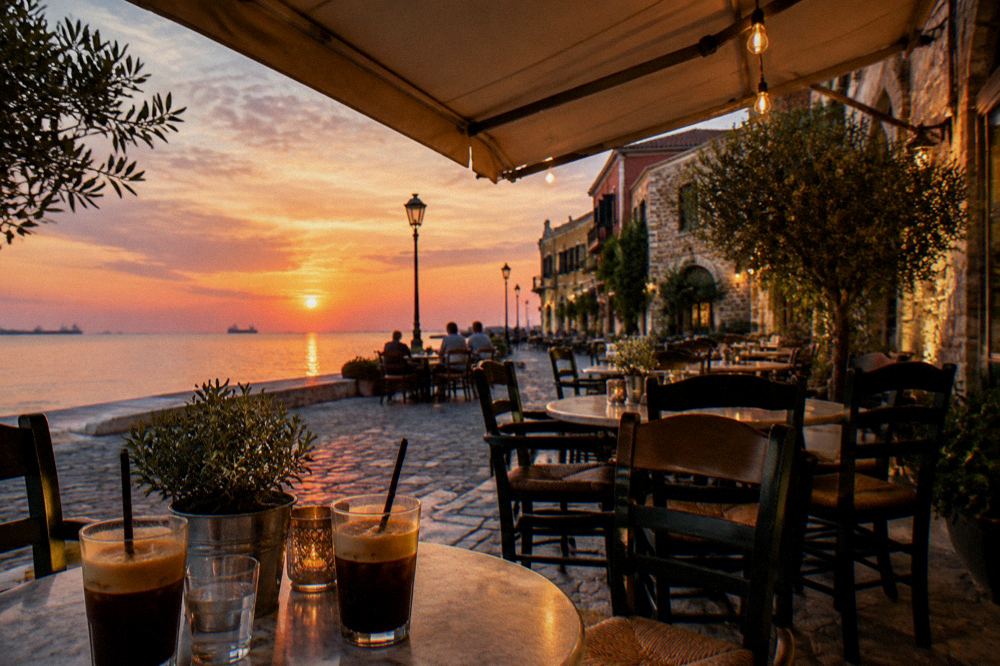
Ladadika, the old commercial quarter near the port, is the district most associated with evenings: its cafes and bars fill the low buildings around the lanes, and the atmosphere shifts from coffee by day to nightlife after dark. The transition matters for planning, since an afternoon cafe stop in Ladadika becomes something closer to Thessaloniki nightlife as the evening goes on.
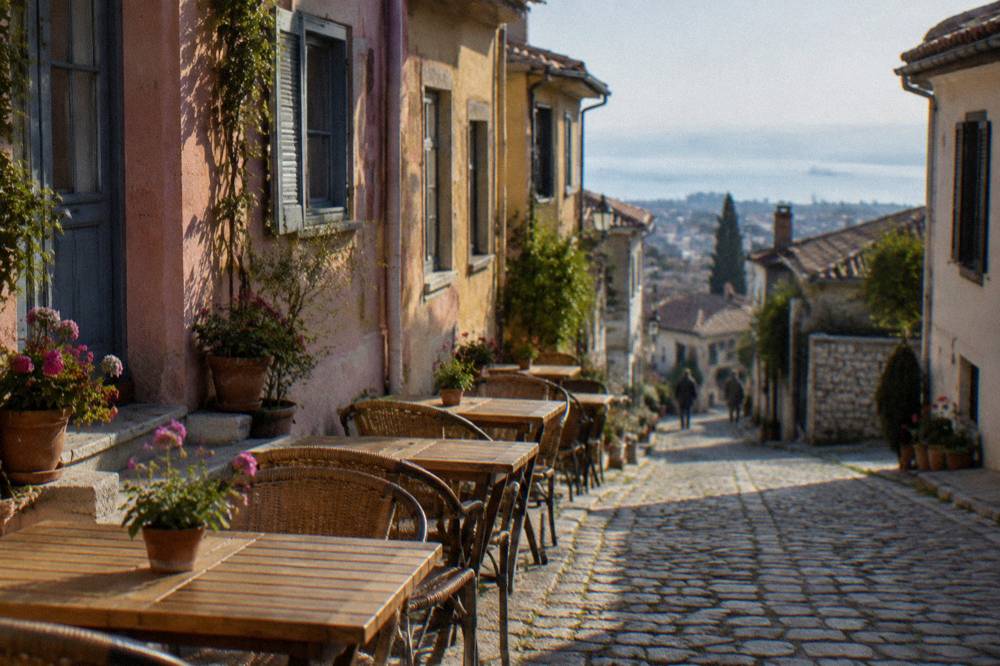
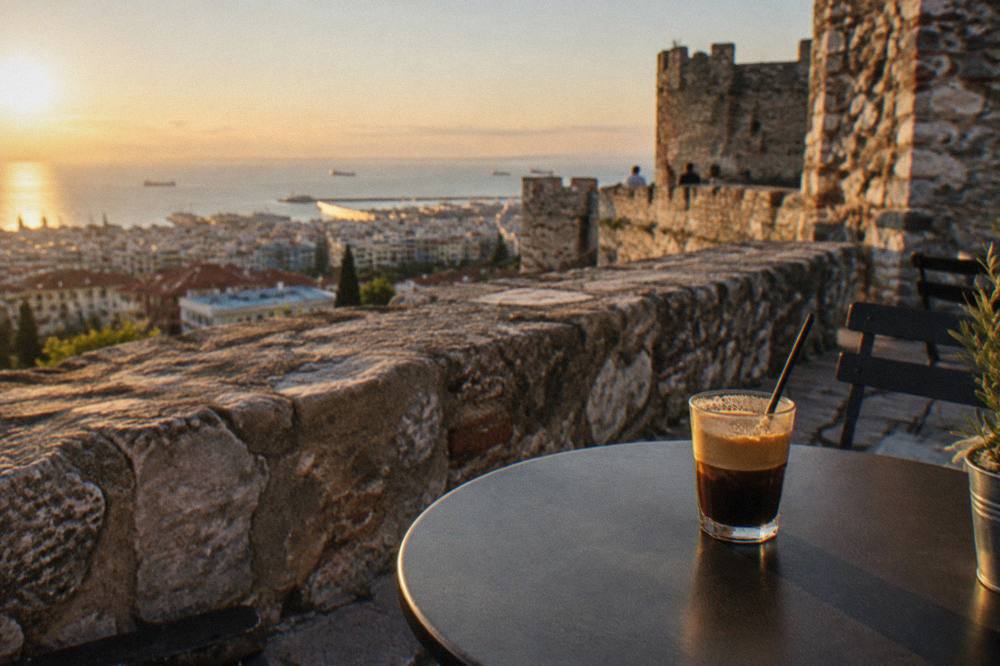
Ano Poli, the upper town inside the old Byzantine walls, is the opposite register: fewer tables, stone lanes, and views out over the whole city and the gulf. The Heptapyrgion fortress sits at the top of the district, and the UNESCO-listed walls, part of the 1988 inscription of fifteen Paleochristian and Byzantine monuments, run through it. A coffee in Ano Poli pairs naturally with the walk up through the neighbourhood rather than with a busy square.
Kalamaria, reached by the metro since the Kalamaria extension opened on 27 August 2026, is the residential southeast of the city, where the cafe crowd is local rather than visiting. Its squares and seafront at Nea Krini and Aretsou hold a cafe life that runs on its own timetable, and getting there is now a matter of a standard metro ticket: 0.60 euro basic, 2.50 euro for the 24-hour daily ticket, per the Thessaloniki Metro's ticket page.
| Area | Character | Best Time Of Day | What Pairs With It |
|---|---|---|---|
| Aristotelous Square | Seafront square, formal terraces | Morning to late afternoon | The White Tower and the Nea Paralia walk |
| Ladadika | Lanes near the port, evening weight | Late afternoon into night | Dinner and nightlife |
| Ano Poli | Stone lanes above the centre, views | Morning | The walls, the Heptapyrgion, the view |
| Kalamaria | Residential squares, local crowd | Any time | Nea Krini seafront, metro ride out |
For a first visit based in the centre, the practical split is simple: seafront and square tables by day, Ladadika after sunset, Ano Poli once, for the morning view. Choosing a base near any of these is covered in where to stay in Thessaloniki.
A guided angle exists too. A walking tour that covers the city's main sights and its less obvious corners doubles as a route map for where to come back to for coffee, and the food tours below go one further, pairing the drinks culture with the tastes sold around it.
How Do You Order Coffee In A Thessaloniki Cafe?
Ordering is short and standard: ask for a freddo espresso or a freddo cappuccino, say how sweet you want it, sketos for no sugar, metrios for medium, glikos for sweet, and the server takes the rest, with payment at the table at the end. The sweetness scale is applied to the coffee itself, most directly in the espresso version, and asking for it is the one piece of vocabulary that changes what arrives. Milk adjustments belong to the cappuccino side, and the foam on a freddo cappuccino is what separates it from an iced latte style drink.
The vocabulary is small enough to learn quickly, and it applies citywide.
| Greek Term | What It Means | Applied To |
|---|---|---|
| Freddo espresso | Espresso shaken or blended over ice | The default cold coffee |
| Freddo cappuccino | Cold espresso with cold milk foam | The second default |
| Sketos | Without sugar | Either drink |
| Metrios | Medium sweet | Either drink |
| Glikos | Sweet | Either drink |
| Ellinikos | Traditional Greek coffee, boiled in a small pot | The hot alternative |
The ellinikos, the traditional boiled coffee served in a small cup with its grounds, is the older register of Greek coffee life and remains widely available, and it is the drink to order if you want the seated-slow version of the ritual rather than the iced one.
Two practical notes hold everywhere. First, table service is the norm: you sit, and the server comes to you. Second, the emergency number in Greece is 112, a standard EU-wide number, worth knowing in any city, and the tourist information centre reported at Aristotelous Square is the desk to ask for a current cafe recommendation in person, since its details can be confirmed on arrival.
What Should You Order Beyond Freddo In Thessaloniki?
Beyond the two freddos, the standard orders are Greek coffee (ellinikos), filter coffee, tea, fresh juices in season, and, in the evening hours, the cafe menu shifts toward ouzo and small plates in the places that work as ouzeri after dark, so a Thessaloniki cafe can serve three different purposes in one day. The drinks list above is the confirmed frame. Anything more specific, a signature drink, a house special, a named bakery item beside the coffee, is outside what this site can verify and is left to the menu you are handed.
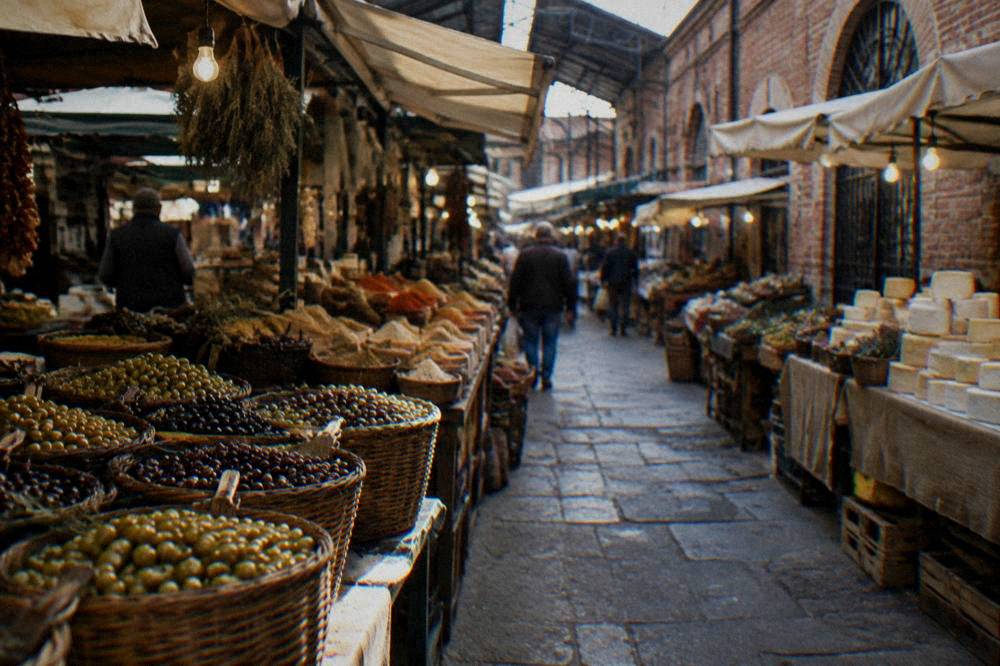
The food that sits beside Thessaloniki coffee has its own guide. Bougatsa, the filled pastry that belongs to the city's mornings, and the wider sweet and savoury repertoire are covered in what to eat in Thessaloniki and in the bougatsa guide, and the market halls, Modiano Market and Kapani Market, are the named places where the raw version of that food is sold.
| Part Of Day | Typical Cafe Order | Typical Setting |
|---|---|---|
| Early morning | Greek coffee or filter, something baked | Near the markets, city centre |
| Late morning | Freddo espresso or cappuccino | Aristotelous Square, seafront |
| Afternoon | Freddo, juice, or a sweet | Ano Poli, Kalamaria |
| Evening | Coffee, or a shift to ouzo and plates | Ladadika |
The overlap between cafes and the evening economy is real but not documented venue by venue here. What is confirmed is the structure of the city: the port-side quarter that turns lively at night, the markets that anchor the food life, and the food tour products listed below, which cover the tasting side of the city with a local guide and render their own current prices and details. More of these guides are collected on Thessaloniki Travel Guide.
When Is Cafe Season In Thessaloniki?
Cafe season in Thessaloniki runs strongest from April through October, when the mean daily high climbs from 19.1 C in April to 31.7 C in July and back to 21.2 C in October, per the HNMS Thessaloniki Mikra station record, 1959 to 2010, and the freddo is the natural order for all of it. Winter cafe life continues indoors, and the city's mean January high of 9.3 C pushes the order toward the ellinikos, but tables do not disappear. The full picture of the calendar is in Thessaloniki weather and the seasonal planning guide to the best time to visit Thessaloniki.
| Month | Mean High C | Mean Low C | Rain Mm |
|---|---|---|---|
| April | 19.1 | 7.9 | 36.1 |
| May | 24.6 | 12.6 | 44.2 |
| June | 29.4 | 17.0 | 29.8 |
| July | 31.7 | 19.3 | 23.8 |
| August | 31.4 | 19.1 | 19.3 |
| September | 27.1 | 15.4 | 29.8 |
| October | 21.2 | 11.3 | 43.0 |
Figures are HNMS Thessaloniki Mikra station, 1959 to 2010. December has the highest monthly rainfall total in that record, 55.1 mm, and August the lowest, 19.3 mm, which is one more reason the outdoor season peaks in the months above.
Two calendar anchors matter for cafe planning. The Thessaloniki International Film Festival, whose 67th edition ran 5 to 15 November 2026, fills the centre in November and gives the indoor cafe life a festival crowd, and the Dimitria festival, reported at 1 to 26 October 2026, does the same in October. Neither changes where the cafes are, only how full the tables are, and both are covered in the film festival guide.
How Do Cafes Fit Into A Day Of Sights In Thessaloniki?
A cafe stop slots naturally between every cluster of sights: coffee at Aristotelous Square before the seafront walk to the White Tower, a freddo in Ano Poli after the walls and the Heptapyrgion, and a table in Ladadika before dinner, because the city's sights and its cafe areas sit inside the same walkable centre. The White Tower, the landmark on the Nea Paralia, costs 8 euro full and 4 euro reduced from 1 April 2026, per the Museum of Byzantine Culture's visiting page, and is open daily 08:00 to 21:00 in summer and 08:30 to 15:30 in winter. The Museum of Byzantine Culture itself, a short walk inland, is 10 euro full and 5 euro reduced.
A sample structure for one day, with coffee as the joints of the day:
| Time | Activity | Coffee Stop |
|---|---|---|
| 09:00 | Aristotelous Square and the centre | First coffee on the square |
| 11:00 | White Tower and the Nea Paralia walk | Seafront freddo break |
| 13:00 | Lunch near the markets | Greek coffee after the meal |
| 16:00 | Ano Poli, the walls, the Heptapyrgion | Table with the view |
| 20:00 | Ladadika | Evening drink before dinner |
The metro makes the Kalamaria version of this easy: Line 1 has run since November 2024, the Kalamaria extension since 27 August 2026, and the service runs 05:15 to 00:30 Sunday to Thursday and 05:15 to 02:00 Friday and Saturday, per the operator's own page. The full transport picture, including the airport run, is in Thessaloniki airport to city centre, Thessaloniki metro and getting around Thessaloniki, and the wider sight list lives on the things to do in Thessaloniki page.
For visitors with more than a day, the same rhythm repeats against day trips: Meteora is about 228 km away and a full day, Vergina about 62 minutes by road, Pella about 43, all free-flow estimates from routing data, and each returns you to the city in time for an evening table in Ladadika.
Can You Experience Thessaloniki Cafe Culture On A Tour?
Yes, through food and walking tours rather than cafe-specific products: a traditional Greek food tour with a local covers the tastes and tables of the city, a best-of walking tour covers the areas where the cafe life happens, and a hop-on hop-off bus ties the cafe districts together for visitors who want the geography first.
The three picks serve three different travellers. The food tour fits this page's theme directly. The best-of tour covers the city's sights and hidden corners in one walk, which doubles as reconnaissance for the areas to return to for an unhurried coffee. The hop-on hop-off bus suits a first day or a short stop, since it passes the seafront, the centre and the districts a cafe plan would use, and its listing carries its own current terms. If a food-focused visit is the goal, read what to eat in Thessaloniki alongside the tour pages, and check the Thessaloniki budget guide for how a day of coffee and food spending is best structured.
For anyone planning a longer stay built around slow mornings, the where to stay in Thessaloniki guide maps the districts against the cafe areas described above, and free things to do in Thessaloniki lists what costs nothing, which the seated coffee ritual usefully is not, at least not for the coffee.
Common Questions About Thessaloniki Cafes
What coffee is Thessaloniki famous for?
Thessaloniki, like the rest of Greece, runs on the freddo: freddo espresso and freddo cappuccino, served cold and consumed slowly at a table. The traditional boiled Greek coffee, ellinikos, is the older order and remains standard.
How much does a coffee cost in Thessaloniki?
Prices vary by area and season, and the only reliable answer is the menu at the table. Confirm before ordering if the budget is tight.
Do Thessaloniki cafes open all day?
As a general pattern, Greek cafes serve from morning into the evening, and evening venues in districts such as Ladadika run later. Confirm hours locally for any specific table.
Is it normal to sit a long time over one coffee in Thessaloniki?
Yes. The seated, unhurried coffee is the norm rather than the exception in Greek cafe culture, and a single order holding a table for an hour is ordinary. Table service, water with the coffee, and payment at the end are the standard flow.
What is the difference between freddo espresso and freddo cappuccino?
Freddo espresso is espresso shaken or blended over ice. Freddo cappuccino is the same cold base topped with a thick cold milk foam. Both take the sugar scale sketos, metrios or glikos, and both are the default cold orders in Thessaloniki.
Which area is best for cafes in Thessaloniki?
Aristotelous Square and the seafront for the setting, Ladadika for evenings, Ano Poli for slow mornings with the view over the city and the Thermaic Gulf, and Kalamaria for a local residential crowd, reachable by metro since the Kalamaria extension opened on 27 August 2026.
Freddo culture in Thessaloniki is less a list of venues than a habit to join: order cold, sit long, and let the coffee mark the hours of the day between the White Tower, the markets, the walls of Ano Poli and the lanes of Ladadika. For the tasting side of the city, the food tours above cover the ground this page deliberately leaves unnamed, and their live listings carry the current prices and terms.