Koulouri: The Sesame Ring On Every Corner
Koulouri is the sesame-crusted bread ring sold from street carts across Thessaloniki, and this guide sets out what the record says about it, where to look for it, and how to build a day around it in Greeces second city.
Short answer
Koulouri in Thessaloniki is a ring-shaped bread roll coated in sesame, sold from street carts and market stalls rather than sit-down restaurants. This page explains what it is, where to find it around Aristotelous Square, Kapani Market and Modiano Market, and how it fits a walking day in Central Macedonia's coastal second city.
Thessaloniki, the second city of Greece, sits on the Thermaic Gulf in Central Macedonia, and one food appears on its streets from early morning onward: koulouri, a ring-shaped bread roll crusted with sesame seeds, sold from carts and market stalls rather than from restaurant menus. The municipal gastronomy site references UNESCO and the Creative Cities Network, which tells you how seriously this city treats its food, and koulouri is the everyday end of that reputation, the thing you buy with coins and eat while walking.
What Is Koulouri In Thessaloniki?
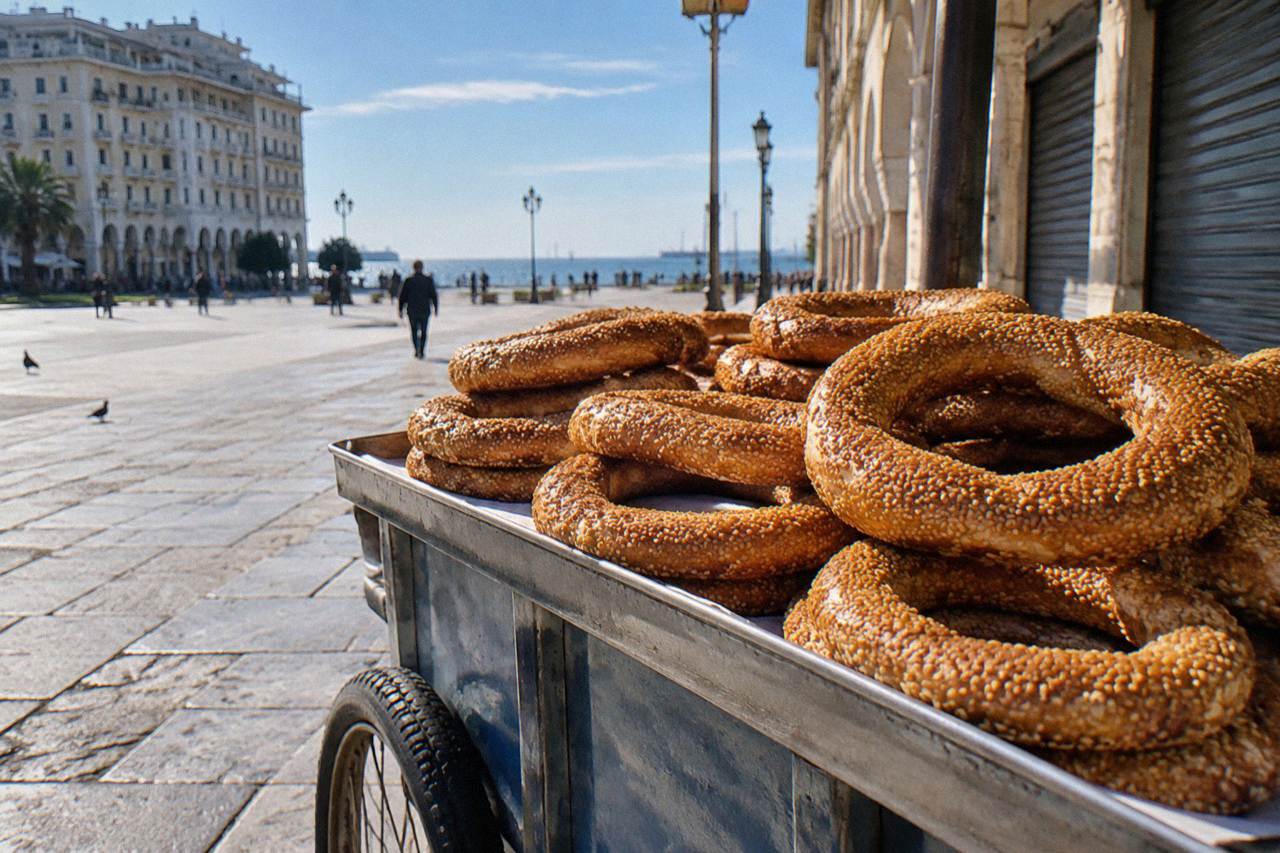
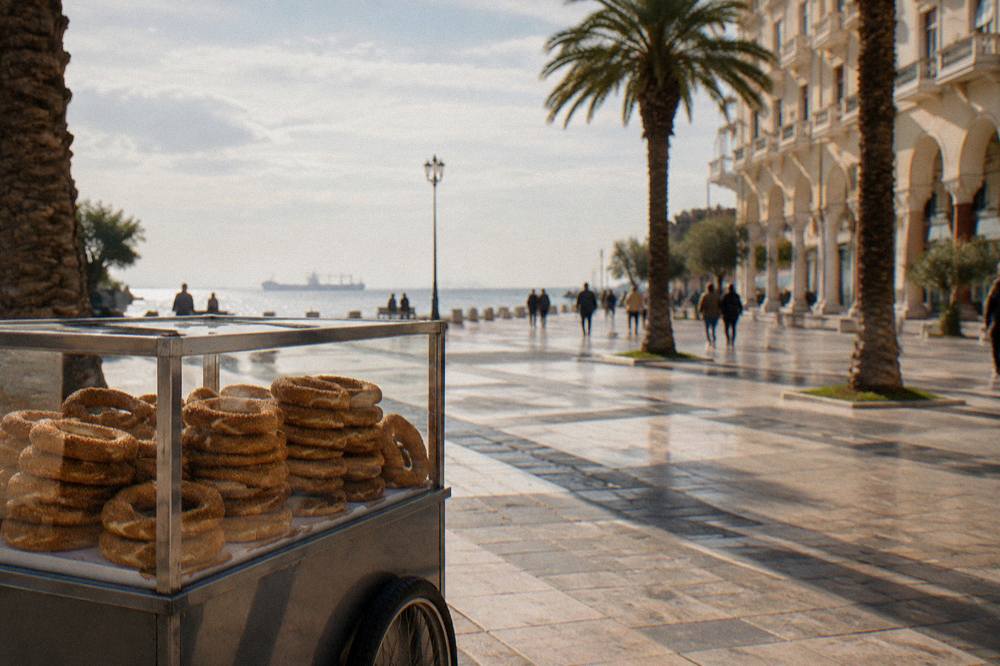
Koulouri is a ring-shaped bread roll coated in sesame seeds, baked fresh and sold by the piece from street carts, bakery counters and market stalls across Thessaloniki, rather than served in restaurants. It is street food in the plainest sense: bread, sesame and a short walk between the oven and the hand that sells it. The name and the object travel across the eastern Mediterranean, and in this city it is part of the ordinary morning landscape.
What this site can state about koulouri is what the object is and where it sits in the city's food life: a sesame bread ring, sold informally, eaten informally.
What can be said with confidence is the setting. Thessaloniki is a coastal city whose food culture the municipality itself promotes, and the everyday foods of that culture are bought on the street and in the markets. Koulouri belongs to that layer, alongside the other famous morning bread of the city, bougatsa, which has its own guide at bougatsa in Thessaloniki. Where bougatsa is a filled pastry eaten sitting down with coffee, koulouri is the walking version, and the two together cover the morning hours.
Where Do You Find Koulouri In Thessaloniki?
The reliable places to look for koulouri in Thessaloniki are the streets around Aristotelous Square, the city's central square on the Thermaic Gulf waterfront, and the two named central markets, Kapani Market and Modiano Market, both long-standing food institutions of the city centre. Carts and bakery counters, not restaurant menus, are where the ring is sold. Wherever you are staying, the search is short: follow the morning foot traffic.
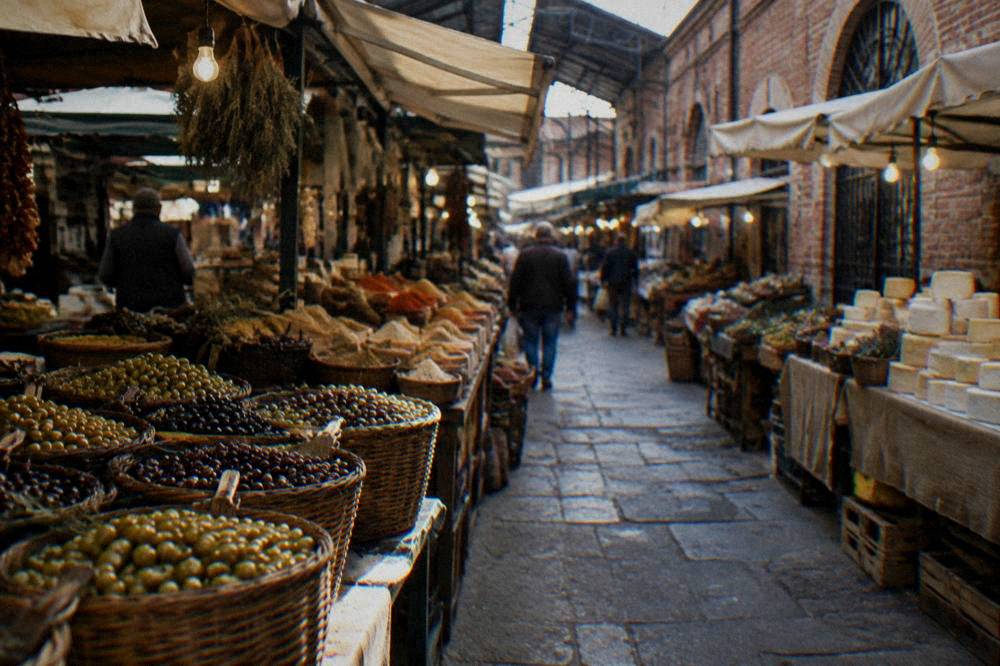
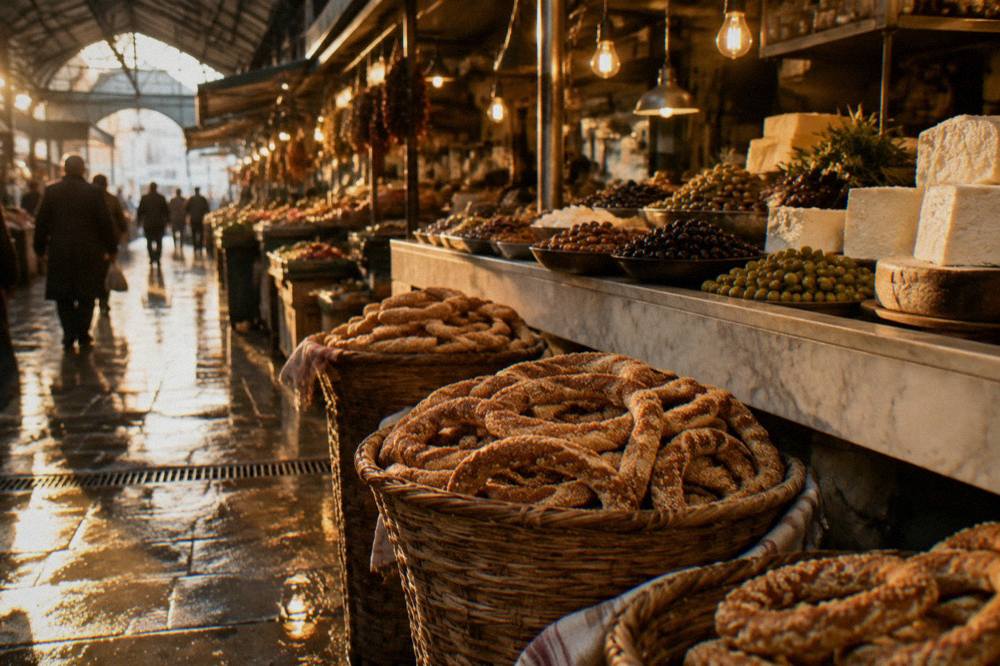
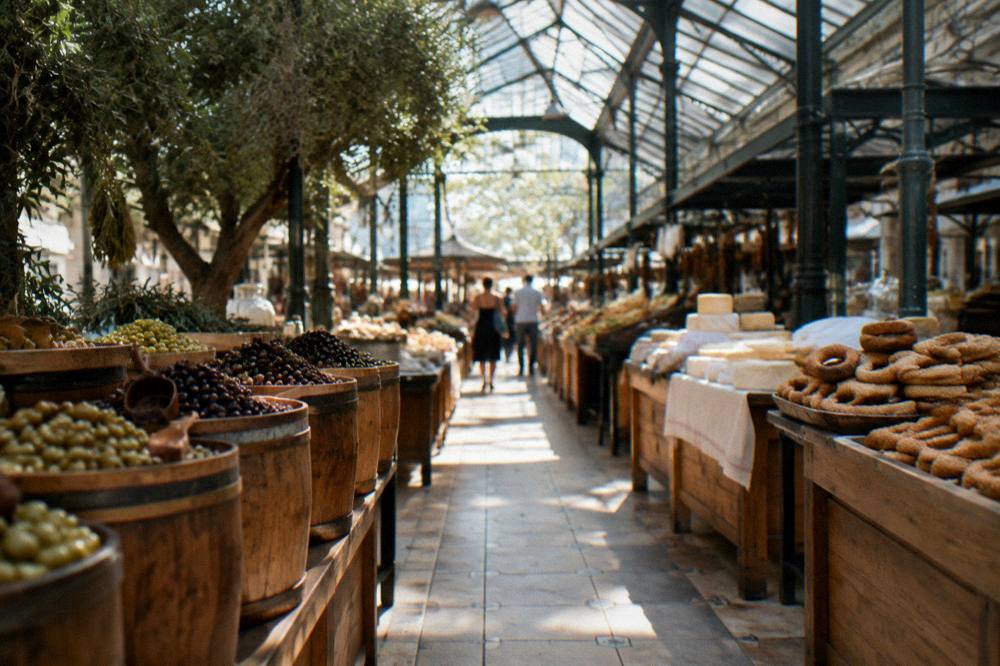
A market is the natural habitat of koulouri: bread and sesame vendors, buyers moving fast, food eaten standing.
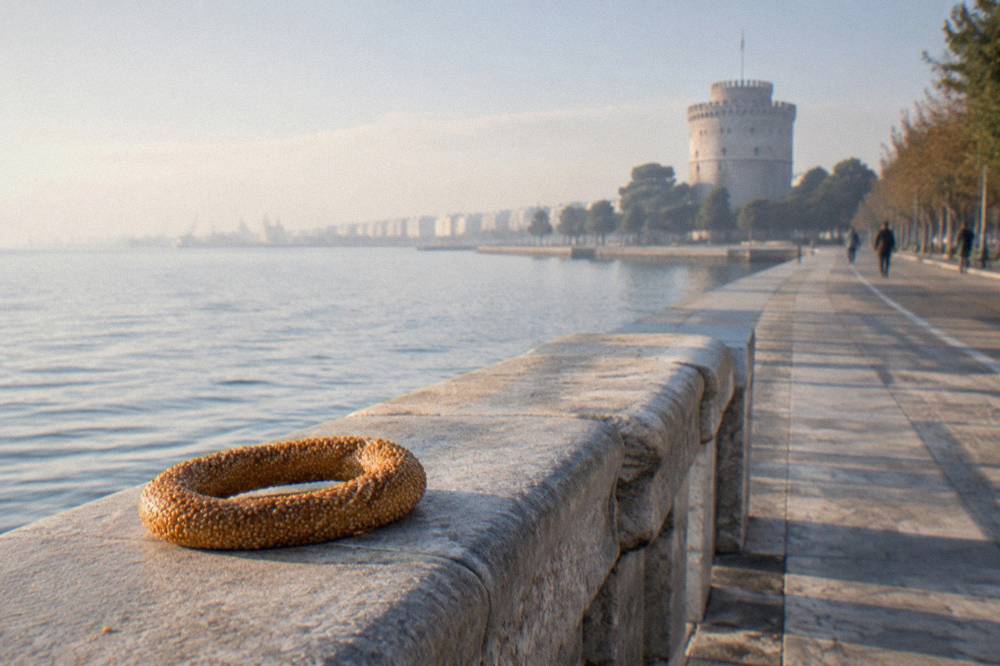
The streets between the markets and the seafront tell the same story. Aristotelous Square, designed as part of the reconstruction plan that followed the Great Fire of 1917, is the city's central open space, and the walk from there along the Nea Paralia promenade is the classic morning route of the city. A koulouri bought near the square and carried to the waterfront is a Thessaloniki morning in two acts, and it costs less than any museum ticket in the city, even before you check the budget guide to Thessaloniki.
How Does A Koulouri Day In Thessaloniki Actually Work?
A realistic koulouri day in Thessaloniki runs from a market or square-side cart in the morning, along the seafront promenade past the White Tower, up into Ano Poli under the Byzantine walls by afternoon, and back down to the Ladadika district in the evening, all on foot or on the metro, whose basic ticket costs 0.60 euro. The ring is the constant; the city supplies the route.
The Thessaloniki Metro is open: Line 1 opened in November 2024 and the Kalamaria extension, five further stations, was inaugurated on 27 August 2026. The Thessaloniki Metro's ticket page states a basic single ticket of 0.60 euro, a reduced ticket of 0.30 euro and a 24-hour daily ticket of 2.50 euro, with running hours from 05:15 to 00:30 Sunday to Thursday and 05:15 to 02:00 Friday and Saturday.
| Metro fact | Figure | Source basis |
|---|---|---|
| Basic single ticket | 0.60 EUR | Thessaloniki Metro ticket page |
| Reduced single ticket | 0.30 EUR | Thessaloniki Metro ticket page |
| 24-hour daily ticket | 2.50 EUR | Thessaloniki Metro ticket page |
| Hours, Sunday to Thursday | 05:15 to 00:30 | Thessaloniki Metro site |
| Hours, Friday and Saturday | 05:15 to 02:00 | Thessaloniki Metro site |
| Line 1 opening | November 2024 | Thessaloniki Metro press release |
| Kalamaria extension | Inaugurated 27 August 2026 | Thessaloniki Metro press release |
The White Tower stands on the seafront, the Nea Paralia is a promenade, not a swimming beach, and Ano Poli is the old upper town inside the Byzantine walls, whose visible remains are part of the UNESCO inscription of fifteen Paleochristian and Byzantine monuments made in 1988. A morning ring, a waterfront walk, an afternoon climb and an evening in Ladadika use almost none of that transport budget, which is the point: the city centre is compact, and the getting around guide and the metro guide cover the details.
Koulouri Or Bougatsa: Which Morning Bread Suits Your Thessaloniki Plan?
Koulouri and bougatsa are the two morning breads of Thessaloniki, and the practical difference is form and pace: koulouri is a small sesame-crusted ring made for eating while walking, while bougatsa is a filled pastry served warm, traditionally eaten sitting with coffee.
Both foods appear on the wider what to eat in Thessaloniki guide, and the honest comparison is about your day. If the plan is a long walking morning, the markets first and then the seafront, koulouri is the food that moves at that speed. If the plan is a slow start, one café table and a newspaper, bougatsa is that morning.
What the record does support is the city around both. Morning in central Thessaloniki is a food economy of carts, bakeries and markets, and it has been since long before the food tours arrived. The municipal gastronomy site's connection to UNESCO's Creative Cities Network is the official signal of how the city frames this, and a morning spent between Kapani Market, Modiano Market and the seafront is the unguided version of the same idea.
When Is Koulouri Season In Thessaloniki?
Koulouri is sold year-round in Thessaloniki, but the comfortable months for the walking-and-eating rhythm it belongs to are April, May, June, September and October, when the HNMS Thessaloniki Mikra station record, 1959 to 2010, shows mean daily highs between 19.1 and 29.4 C and monthly rainfall between 29.8 and 44.2 mm. July and August are hotter, at 31.7 and 31.4 C mean highs, and winter mornings are cool, with a January mean low of 1.5 C.
Those figures are a weather-station record, the HNMS Thessaloniki Mikra station means for 1959 to 2010, and they describe the climate the street food sits in. The full index of guides sits on Thessaloniki Travel Guide.
| Month | Mean high C | Mean low C | Rain mm | Rain days |
|---|---|---|---|---|
| Jan | 9.3 | 1.5 | 37.7 | 11.5 |
| Feb | 11.0 | 2.3 | 35.0 | 10.7 |
| Mar | 14.3 | 4.7 | 37.9 | 12.1 |
| Apr | 19.1 | 7.9 | 36.1 | 11.1 |
| May | 24.6 | 12.6 | 44.2 | 11.0 |
| Jun | 29.4 | 17.0 | 29.8 | 7.9 |
| Jul | 31.7 | 19.3 | 23.8 | 6.7 |
| Aug | 31.4 | 19.1 | 19.3 | 5.1 |
| Sep | 27.1 | 15.4 | 29.8 | 7.0 |
| Oct | 21.2 | 11.3 | 43.0 | 9.3 |
| Nov | 15.5 | 7.1 | 52.8 | 11.0 |
| Dec | 10.9 | 3.2 | 55.1 | 12.7 |
The event calendar matters too, because festival weeks put more feet on the same streets. The 90th Thessaloniki International Fair ran 5 to 13 September 2026, the Dimitria festival was reported for 1 to 26 October 2026, and the 67th Thessaloniki International Film Festival runs 5 to 15 November 2026. The best time to visit guide works through the trade-offs, and the weather guide holds the full climate detail.
Can You Take Koulouri On A Day Trip From Thessaloniki?
Yes, and the drive times make the case: Pella is about 43 minutes by road from Aristotelous Square, Vergina about 62, Dion about 67, Edessa about 82 and Meteora about 154, so a bag of koulouri bought in the morning is a reasonable companion for any of them. Meteora, at about 228 km to Kalambaka, is a full day, not a half day, and the drive times below are free-flow figures, with no traffic, parking or stops.
The table is computed over OSM routing from Aristotelous Square and should be read as "about". What it buys you is a sense of scale: the ancient-Macedonia circuit of Pella and Vergina is a morning-and-afternoon loop, Halkidiki's two peninsulas are reachable through the Nea Moudania gateway at about 57 minutes, and the big one, Meteora, justifies an early cart stop and a long day. Each destination has its own guide on this site, including Vergina, Pella and Meteora, but note that only the URL list on this page is live, so use the site's day-trip section for those.
| Destination from Aristotelous Square | Road distance | Free-flow time |
|---|---|---|
| Perea | 23.0 km | about 28 min |
| Pella | 45.7 km | about 43 min |
| Vergina (Aigai) | 68.0 km | about 62 min |
| Kassandra (Kallithea) | 86.2 km | about 78 min |
| Dion | 90.1 km | about 67 min |
| Edessa | 90.3 km | about 82 min |
| Sithonia (Nikiti) | 97.2 km | about 96 min |
| Ouranoupoli | 129.9 km | about 139 min |
| Meteora (Kalambaka) | 227.5 km | about 154 min |
One correction worth carrying onto any day trip: the boats from Ouranoupoli view the Mount Athos coast from the sea and do not land, and entry to Athos itself requires a permit and is men only, as covered in the Mount Athos cruise reporting. And if the trip is a beach plan rather than a ruins plan, remember that the Nea Paralia in the city is a promenade, not a swimming beach; swimming is at Perea, about 28 minutes by road, or Epanomi. The beaches guide has the detail.
Does Koulouri Show Up On Food Tours In Thessaloniki?
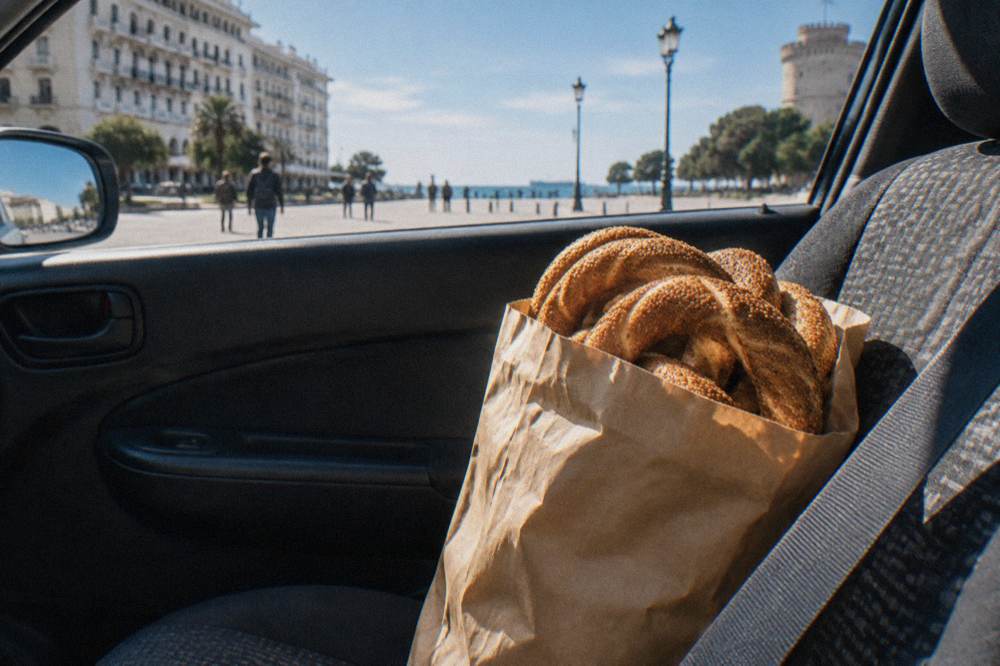
Yes, street food is central to Thessaloniki's guided food walks, and koulouri, as the city's everyday street bread, is squarely in their territory: the tours move through markets and street-food stops, and this site's featured option is a chef-led gastronomic walk whose stops, price and rating are listed on the operator's live listing.
A guided walk solves a real problem for a short visit: the markets are dense, the street foods are many, and a local guide compresses days of wandering into one outing. The featured tour on this page is the chef-led gastronomic food tour, and the tile below shows its current listing figures. It is also worth reading the operator's listing for cancellation terms before you book; the standard pattern across these listings is free cancellation within a window, and the listing, not this page, is the authority on it.
Not every koulouri afternoon needs a guide. The free layer of the city is large: the Arch of Galerius is an open-air monument on Egnatia street, free to view, the working churches such as the Church of Saint Demetrius are free to enter outside services, and the free-admission days at state museums, 6 March, 18 April, 18 May, the last weekend of September and 28 October, put the White Tower and both big museums behind a zero-euro ticket. The free things to do guide expands on all of it.
| Sight | 2026 admission | Notes |
|---|---|---|
| White Tower | 8 EUR full, 4 reduced | In force from 1 April 2026, per the Museum of Byzantine Culture's visiting page |
| Museum of Byzantine Culture | 10 EUR full, 5 reduced | Summer daily 08:00 to 20:00 |
| Archaeological Museum | 10 EUR full, 5 reduced | 09:00 to 17:00, closed Tuesday from 1 November to 31 March |
| Arch of Galerius | Free | Open-air monument on Egnatia street |
| Working churches | Free | Open outside services, liturgical hours vary |
| State free days | 0 EUR | 6 Mar, 18 Apr, 18 May, last Sep weekend, 28 Oct |
How Does Koulouri Fit Thessaloniki's Market Culture?
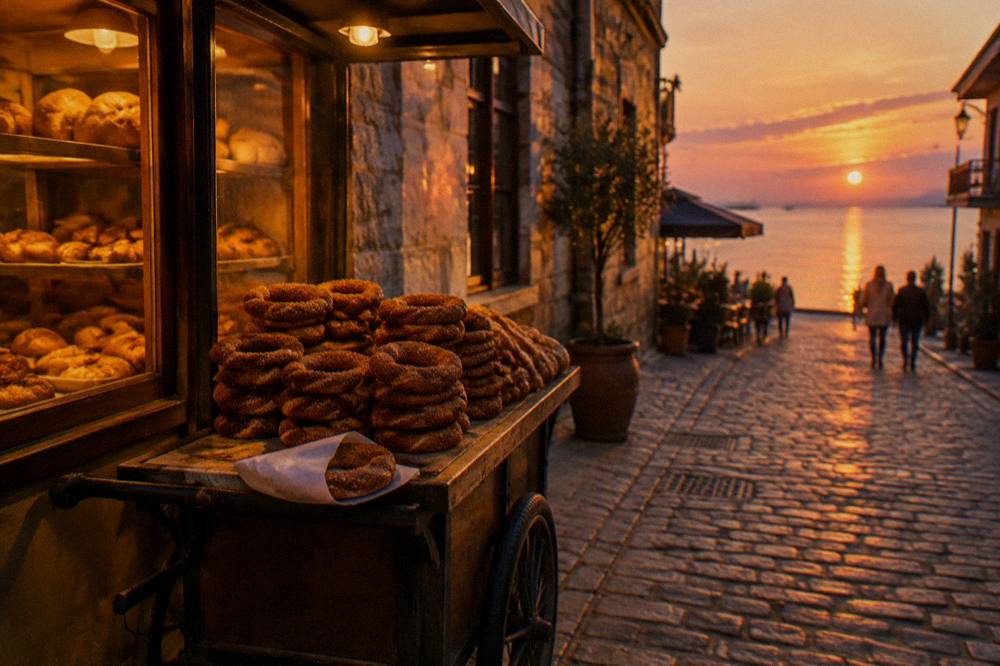
Koulouri sits inside a market culture with clear anchors: Kapani Market and Modiano Market are established central food markets of Thessaloniki, and the city's food identity is promoted by the municipality itself through a gastronomy programme that references UNESCO's Creative Cities Network. The markets are where bread, sesame, olives, cheese and fish share the same few blocks, and the sesame ring is the portable summary of all of it.
This site verifies the markets as named places but not their stall lists, hours or prices, so the guidance is structural rather than specific: go in the morning, when a working market is at full speed, and treat any single stall's story, an inventor claim, an original-recipe sign, as marketing rather than record. The same discipline applies to restaurant claims, which is why the restaurants guide frames the city's dining scene without endorsing inventors or originals that no source supports.
Thessaloniki was founded in 315 BC by Cassander, was liberated on 26 October 1912, and carries fifteen Paleochristian and Byzantine monuments inscribed by UNESCO in 1988. A morning that starts with a sesame ring at a market stall and ends at the Church of Saint Demetrius or the Rotunda covers two thousand years of the same few square kilometres, which is the argument for the compact, walkable plan in the one day guide and its longer siblings.
Can You Make Koulouri At Home After Thessaloniki?
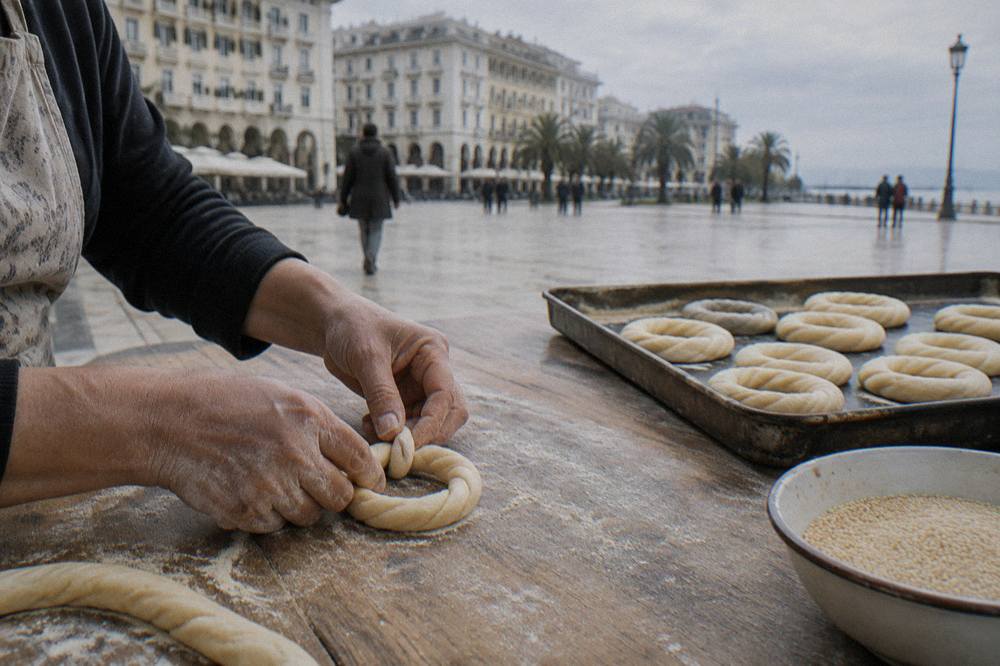
That honesty is the useful kind. A cooking class answers the impulse better than a recipe card: dough, sesame and a kitchen, with the class details carried by the listing rather than typed here. The same logic governs the city's other food-culture experiences, from market tastings to wine trips into northern Greece, all of which appear as product blocks across this site.
For planning the wider food trip, the sequence that works on paper is a street-food morning, a market late morning, a cooking or tasting experience in the afternoon, and a restaurant evening, with the nightlife guide closing the day. Where to base all of this is its own question, and the where to stay guide covers the neighbourhoods: the city centre for the markets, Ano Poli for the walls, Kalamaria for the metro-served southeast.
What Should You Know Before Chasing Koulouri In Thessaloniki?
Before a koulouri-focused visit to Thessaloniki, the facts that matter are these: the metro is open, with a 0.60 euro basic ticket; the city centre is compact and walkable between Aristotelous Square, the markets, the seafront and Ano Poli; the comfortable walking months per the HNMS Thessaloniki Mikra station record, 1959 to 2010, run from April to June and September to October; and dish prices, stall hours and bakery names should be confirmed at the point of sale.
The emergency number in Greece is 112, the currency is the euro, and Greece is a Schengen member, so the practical frame is standard European. The airport, Thessaloniki Airport "Makedonia" (SKG), is about 16 km and 20 minutes by road from Aristotelous Square, and the airport to city centre guide covers the connections, including the OASTH airport bus lines the operator lists. One note on fees: a Greek climate resilience fee exists, is collected by the accommodation, is charged per room per night and is higher from April to October, so expect it on your hotel bill.
Finally, the calendar. Saint Demetrius day falls on 26 October, which is also the city's liberation day, and Ochi Day follows on 28 October with its parade, a dense, interesting fortnight in the city. The 67th Film Festival runs 5 to 15 November 2026. Any of these dates puts you on full streets with the carts out, whatever the HNMS table says about November rain.
Common Questions About Koulouri In Thessaloniki
What is koulouri in Thessaloniki?
A sesame-crusted, ring-shaped bread roll sold by the piece from street carts, bakery counters and market stalls, eaten as everyday street food rather than in restaurants.
Where do you buy koulouri in Thessaloniki?
From street carts and bakery counters around Aristotelous Square and in the two named central markets, Kapani Market and Modiano Market.
How much does koulouri cost in Thessaloniki?
Confirm the price with the vendor when you buy; street bread in Greece is conventionally among the cheaper things you can eat in a day.
Is koulouri the same as bougatsa?
No. Koulouri is a sesame-coated bread ring eaten on the move; bougatsa is a warm filled pastry eaten sitting down, usually with coffee.
When is the best time of year for a koulouri walk in Thessaloniki?
Per the HNMS Thessaloniki Mikra station record, 1959 to 2010, the mean daily highs run from 19.1 C in April to 29.4 C in June and back to 21.2 C in October, with July and August at 31.7 and 31.4 C. This site names no single best month; the choice is yours against the numbers.
Can a food tour include koulouri in Thessaloniki?
Guided food walks move through the markets and street-food stops where koulouri is sold, and this page's featured chef-led gastronomic tour covers that territory. Prices, ratings and durations render on the operator's live listing, not on this page.
The sesame ring is the smallest food in Thessaloniki's repertoire and the one you will pass most often, and a day built around it, one cart, two markets, a seafront walk and a climb to the walls, is a day built around the city itself.